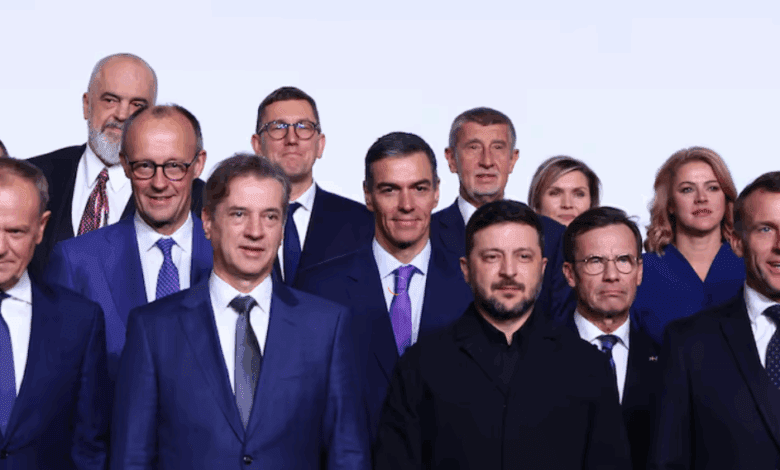
Spain is preparing to take part in shaping a European peacekeeping mission that may be deployed in Ukraine once a ceasefire agreement with Russia is reached. Potential participants include military instructors, engineers, demining experts, and observers. The details of the future operation have been under discussion for over a year, and a recent meeting of leaders from 35 countries in Paris has injected new momentum into the process. However, there are no plans to create a large combat force capable of holding Russian troops at the border. The main goal is to support the Ukrainian army and help restore its capabilities.
The European contingent is expected to comprise several thousand troops rather than tens of thousands. This is due to Russia having around 150 brigades near the borders, a number Europe cannot match. Like other coalition members, Spain is ready to contribute to forming a multinational unit that will fall under European command. Among the partners are Australia, Canada, Japan, Türkiye, as well as the United States, which will not send troops but will guarantee the mission’s security. The operation’s headquarters will be in Paris, with the key objective focused on strengthening Kyiv’s defenses and rebuilding the Ukrainian army after years of heavy losses.
Military specialists
One of the main priorities will be shifting the training of Ukrainian troops directly to Ukraine. Currently, training takes place in European Union countries, including Spain, where 8,500 Ukrainian servicemen have already completed courses. Moving instructors closer to the front line will speed up training and broaden its scope to include technical support and consulting for Ukrainian units.
Spain is also considering sending engineering units. Their tasks would include not only emergency repairs of roads and bridges, but also building long-term fortifications, ammunition depots, and other essential defense infrastructure. Special emphasis is placed on demining: sappers will neutralize unexploded ordnance left after shelling. In the Black Sea, Spanish minesweepers could join efforts to clear mines from the area—Spain’s Navy has five such ships.
Observers and oversight
Another potential role for Spain is participation in a mission overseeing compliance with the ceasefire. Military observers will monitor implementation of agreements, relying both on their presence on the ground and on modern technologies such as drones, satellite intelligence, and electronic surveillance. Europe will be represented on a special commission to investigate violations and determine responsibility. This will require control over airspace and coastal areas.
At the same time, the deployment of large combat units is not being considered. European troops should be provided with self-defense capabilities, but their main task will be support and training rather than combat. All these plans remain under discussion for now: the mission will only begin once a lasting ceasefire has been achieved, and the final parameters will depend on the terms of the future agreement.
Political nuances
The question of the legitimacy of foreign troops is resolved simply: an official invitation from the Ukrainian authorities is sufficient. This makes it possible to bypass the need for UN approval, where Russia has veto power, and excludes direct NATO involvement, which Moscow strongly opposes. To regulate the mission’s status, bilateral or multilateral agreements with Kyiv will be required.
Spain has already made long-term commitments to military support for Ukraine. In 2022, an agreement was signed for the supply of weapons worth 1 billion euros annually for ten years. At the end of last year, the government approved the allocation of 100 million euros to purchase American equipment for the needs of the Ukrainian army. These measures fit into the European Union’s overall strategy to strengthen Ukraine’s defense capabilities, including developing its own military-industrial complex and joint projects with European countries.
Guarantees and risks
Although the European mission cannot completely prevent a possible new Russian offensive, the very presence of foreign military personnel on Ukrainian territory could serve as a deterrent. Should European troops come under attack, the conflict could escalate to a new level—something some experts believe might hold the Kremlin back from further escalation. Additionally, the agreement includes commitments to support Ukraine in the event of renewed aggression, with military, logistical, and intelligence assistance, as well as diplomatic measures and new sanctions.
This framework is reminiscent of Article 5 of the Washington Treaty, which states that an attack against one NATO member is considered an attack against all. However, as diplomats note, the main issue is not wording, but the real willingness to act in the face of a threat. Like other European nations, Spain faces a difficult choice: how to support Ukraine without becoming directly involved in a confrontation with Russia, while also preventing a repeat of recent tragedies.