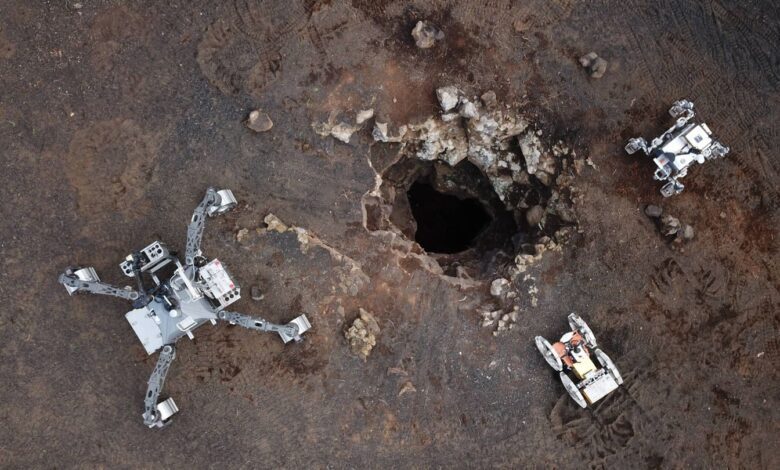
On the island of Lanzarote (Canary Islands), tests have been completed on three new robots designed to explore lunar lava tubes. The trials took place in one of the local volcanic caves, whose conditions closely resemble those that can be found on the surface of the Moon.
The project aims to develop technologies that will enable the exploration of underground structures on Earth’s satellite. Lunar lava tubes are of particular interest to scientists and engineers because they maintain a stable temperature inside and offer natural protection from radiation and micrometeoroids. These features make them potentially suitable for future lunar bases and research stations.
Three robots took part in the trials: SherpaTT, Coyote III, and LUVMI-X. Each has its own specific task. SherpaTT is designed for transporting equipment and collecting data on the surface. Thanks to its compact size, Coyote III can penetrate narrow passages and explore internal structures using radar and other sensors. LUVMI-X is responsible for locating water ice and delivering special sensor cubes to hard-to-reach sections of caves to assess their safety.
The tests on Lanzarote allowed the engineering team to evaluate how the robots interact with each other and handle real-world tasks in challenging conditions. During the trials, specialists created a detailed map of the cave, lowered a sensor cube into one of the chambers, and sent Coyote III for an in-depth exploration of the interior. All stages were completed successfully, confirming the viability of the concept and the potential for deploying such systems on the Moon.
Previously, astronomers discovered several pits on the Moon leading to branching systems of lava tubes. These findings have attracted researchers’ attention, as such structures could be crucial for future lunar exploration missions. Inside the lava tubes, conditions are much milder compared to the open surface, making them appealing for placing equipment and even potential human settlements.
The project is being led by Professor Frank Kirchner from the German Research Center for Artificial Intelligence. A team of scientists and engineers from various European countries has joined forces to develop universal robots capable of operating in extreme conditions on other planets. The Lanzarote tests became a key stage in preparing for future expeditions to the Moon and Mars.
In the coming years, developers plan to further improve the control and communication systems between the robots, and to conduct additional tests in other natural locations similar to lunar conditions. The results are expected to help take the first steps toward exploring the Moon’s underground spaces and ensure the safety of future missions.