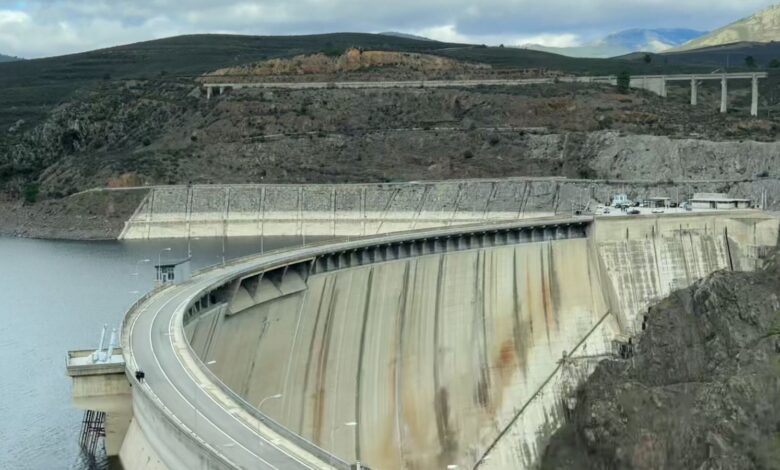
A sharp increase in water levels at Spanish reservoirs has become one of the most notable events of this winter. After prolonged rainfall across almost the entire country, water reserves have reached a level not seen in over ten years. This development has a direct impact on agriculture, energy, and domestic water supply, and may also alter water usage plans in the coming months.
Record figures
According to Elconfidencial, Spain’s reservoirs currently hold 46,229 cubic hectometers of water. This represents 82.5% of their total capacity. Over the past week, the volume grew by 2,888 cubic hectometers, an increase of 5.2%. Similar figures were recorded only in 2014, when water levels reached 46,518 cubic hectometers. The Ministry for Ecological Transition and Demographic Challenge notes that peak rainfall was registered in the Vigo area, where 165.9 liters per square meter fell.
The recovery of water resources is being observed in almost every region. The only exception was the Tinto, Odiel and Piedras system, where the level dropped from 95.2% to 93.9%. The other fifteen river basins have seen increases. Eight of them have surpassed 90% capacity: Galicia Costa, Internal Basins of the Basque Country, Tinto-Odiel-Piedras, Internal Basins of Catalonia, Guadalete-Barbate, Western Cantabrian, Eastern Cantabrian, and Miño-Sil.
Regional dynamics
The increase is especially notable in the Ebro basin, where the water level rose from 74.3% to 81.5%—an increase of 7.2 percentage points in one week. In Guadalquivir, the level grew from 74.4% to 80.6%, and in Segura—from 39.4% to 45.6%. Significant changes were also recorded in the Guadalete-Barbate (+5.8%), Duero (+5.5%), and Guadiana (+5.1%) basins. Compared to last year, the total water reserves exceed last year’s by 16,380 cubic hectometers, and the ten-year average by 15,677 cubic hectometers.
Almost all basins, except Segura, are more than 61.8% full, which matches the level in the Júcar basin. This means that the water supply situation in most regions of Spain has stabilized and even improved compared to previous years. In some areas, such as Galicia and the north of the country, reservoirs are almost completely filled.
Impact on regions
Recovery of water reserves is especially important for agricultural areas, where drought in recent years has led to reduced harvests and rising food prices. Now, farmers can count on a more stable water supply, reducing the risks for crops and livestock. In cities and industrial zones, water use restrictions are also expected to be eased.
According to Elconfidencial, in some natural parks and tourist destinations such as Castilla-La Mancha and Aragón, waterfalls and rivers have reached their peak levels after heavy rainfall. This has attracted the attention of tourists and local residents, who have not seen such landscapes in many years. Meanwhile, authorities continue to monitor dams and hydraulic structures to prevent possible accidents due to the sudden influx of water.
Context and similar events
In recent years, Spain has repeatedly faced water shortages, especially in the southern and eastern regions. In 2022 and 2023, reservoir levels dropped to critical lows, resulting in restrictions on irrigation and domestic use. Many municipalities were then forced to seek alternative sources and implement conservation programs. Similar sharp changes in water reserves also occurred in the early 2010s, when seasons of heavy rainfall quickly replenished water resources after periods of drought. Such fluctuations remain a characteristic feature of Spain’s climate, requiring constant monitoring and adaptation of water management policies.