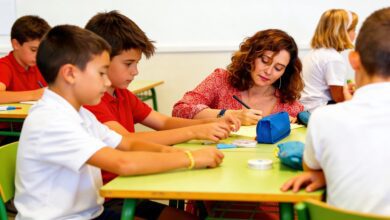
Spanish schools are once again debating how modern technologies affect the quality of education. The decision by some teachers to require written assignments exclusively by hand has sparked heated discussions. For many parents and students, this seems like a step backward, but supporters of the method are convinced: handwriting activates the brain and helps absorb material more effectively.
Educator and academic Felipe López, known on social media, explained why he refuses to abandon traditional assignment submission methods. Even if a student uses artificial intelligence to search for information, rewriting the text by hand, in his view, triggers thought processes that are rarely engaged when typing. According to López, this approach not only aids memory, but also develops critical thinking.
Teachers’ arguments
López points out that handwritten work compels students not just to copy, but to comprehend and analyze the material. He believes that when a student writes on paper, they are forced to reflect, question, and formulate doubts. In the teacher’s opinion, this is the foundation of deep learning rather than mechanical reproduction of information.
In recent years, interest has grown in Spain in how digital technologies are transforming the educational process. Many teachers report that children are increasingly relying on gadgets and losing their handwriting skills. In response, some schools are returning to traditional methods, believing they are more effective for developing memory and thinking.
Expert opinions
The stance of Spanish educators is shared by international experts. Studies conducted in various countries show that people retain information better when they write it by hand. Professor of linguistics Naomi Susan Baron notes that the link between handwriting and memory is statistically proven. In Japan, Norway, and the US, experiments have shown that handwritten notes are remembered better than those typed on a computer.
Other specialists emphasize that the process of handwriting involves more complex brain activity. Mellissa Prunty, a researcher from the UK, claims that when children learn to write, they connect sounds with letter shapes, which helps develop reading and spelling skills. Such a level of engagement is hard to achieve when using digital devices.
Public response
The decision to bring back handwritten assignments has sparked mixed reactions among parents and students. Some consider it an outdated practice, while others see it as a necessary step to maintain educational quality. In some regions of Spain, there are already initiatives to limit the use of tablets and laptops in classrooms, aiming to restore children’s habit of writing on paper.
Educators note that even if a student uses artificial intelligence to prepare an assignment, the very process of rewriting helps them better understand and retain the material. This is especially important in an era where access to information is nearly limitless and analytical and critical thinking skills are particularly valuable.
Education trends
In recent years, there has been growing debate in Europe and the US about how to strike a balance between traditional and digital learning methods. Some countries are already implementing programs to develop handwriting skills, despite the abundance of electronic devices. Spain is no exception: there is a growing interest in bringing back handwritten assignments, especially in primary and secondary schools.
Teachers emphasize that handwriting not only improves memory but also helps children express their thoughts, build logical connections, and analyze information. As technology continues to advance rapidly, these skills are becoming increasingly important.
In recent years, the role of technology in education has been a recurring point of debate in Spanish schools. In 2024, several autonomous communities discussed the possibility of a full or partial ban on mobile phones during lessons. Many teachers noted at the time that children’s reading and writing skills were declining, along with overall literacy levels. In response, some schools began reintroducing dictations and handwritten assignments. These initiatives found support among some parents, but also sparked dissatisfaction among those who believe that schools should keep up with the times. A similar trend is evident in other European countries: in France and Germany, there are ongoing discussions about making handwritten work mandatory in primary classes. Experts believe such measures could help maintain a high standard of education amid the digital revolution.