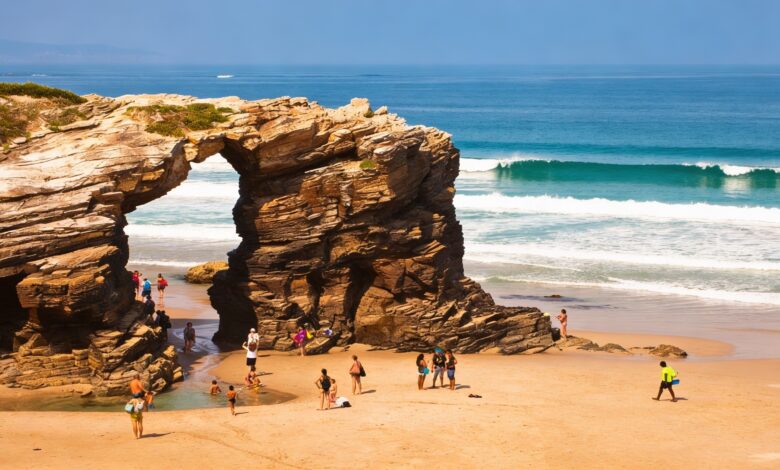
The decision of Spain’s National Court in the case of a young woman’s death at As Catedrais beach in Galicia has set an important precedent for the entire country. For the first time, the court ruled that responsibility for the safety of tourist areas lies not only with visitors, but also with all levels of government. This decision could influence how natural landmarks are managed and tighten safety requirements at popular sites across Spain.
The court case concerned a tragedy in March 2018, when a 24-year-old woman died after a rockfall inside one of the caves at As Catedrais beach (Ribadeo, Galicia). The victim’s family took legal action, arguing that warning signs about possible collapses were not prominent enough and that preventive measures were ineffective. According to El Pais, even though further rockfalls had already occurred that day, access to hazardous areas remained open and no additional safety measures were introduced.
Authorities’ responsibility
The National Audience considered the arguments of all parties: the Ministry for Ecological Transition, the government of Galicia (Xunta), and the municipality of Ribadeo. Each administration tried to shift responsibility to another, citing the division of powers. The municipality argued that the site belongs to state property, the ministry claimed safety control lies with local authorities, and the Xunta referred to its role in regulating visitor access. However, the court concluded that all three levels of government should have taken additional measures to prevent the tragedy.
The court found that the state had previously carried out work to reinforce the cliffs but failed to implement experts’ recommendations for extra safety measures, including the installation of protective nets and continuous monitoring. The municipality, while actively promoting the beach as a tourist attraction, also did not provide an adequate level of protection for visitors. The Xunta, despite developing a plan to manage visitor numbers, failed to account for risks related to weather conditions and ground instability.
Degree of liability and compensation
The court found that the deceased and her companion were aware of the potential danger, as warning signs were displayed on the beach and risk information was provided online when accessing the entry code. Nevertheless, the judges emphasized that the lack of coordinated action between administrations and insufficient precautionary measures were the key factors in the tragedy. As a result, the state, Xunta, and the municipality of Ribadeo are required to pay the victim’s family €73,200 in compensation, which amounts to 40% of the total damages.
The court’s decision could serve as a signal for other regions of Spain, where natural sites attract many tourists but are not always adequately protected. According to RUSSPAIN.COM, such cases may change the way different levels of government interact and lead to stricter visitor protection at natural landmarks.
Implications for tourism
In recent years, incidents involving tourists at natural sites have become more frequent in Spain. For instance, authorities in Catalonia had to restrict access to several caves and gorges after a series of accidents. Other regions, such as Andalucía and Cantabria, are discussing new safety standards for beaches and mountain trails. The question of who is responsible for preventing such tragedies remains unresolved and continues to spark debate among municipalities, autonomous communities, and the state.
Parallels can be drawn with recent court rulings on other high-profile cases, where responsibility for safety was distributed among several government agencies. For example, financing for controversial camps was debated in Navarra, which also raised questions about the division of powers and accountability. You can read more about such disputes between authorities in the report on the financing of camps in Navarra in this analytical overview.
Overall, the decision in the As Catedrais case highlights the need for a comprehensive approach to managing tourist zones and may serve as a starting point for reforming safety systems at natural sites in Spain.
In recent years, Spain has repeatedly faced debates over the division of responsibility for safety at tourist sites. In 2024, a landslide at Nerja beach in Andalusia sparked discussion about the roles of local and regional authorities. In Catalonia, after the Mont-rebei Gorge incident, new visitation regulations were introduced and monitoring of routes was strengthened. Such decisions by courts and authorities show that safety at natural sites remains one of the most pressing issues for the country’s tourism sector.