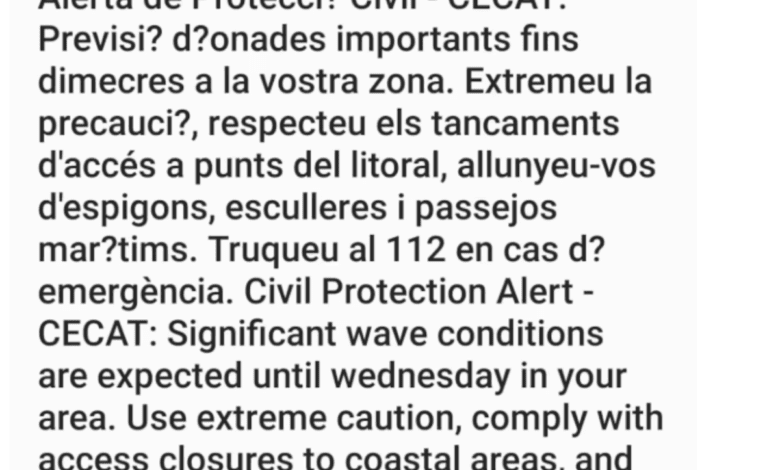
At exactly noon on Monday, residents of Catalonia’s coastal areas were caught off guard. Their mobile phones suddenly blared an urgent alarm that was impossible to ignore. In various municipalities—from Baix Llobregat to Barcelona, Maresme, Selva, Montsià, and Baix Ebre—people simultaneously received emergency alerts. But it wasn’t just the force of storm Harry that startled them: the alert headlines turned out to be surprisingly different.
Some saw the words ‘Civil Alert’ on their screens, while others received the puzzling ‘Presidential Warning.’ Given that President of the Generalitat Salvador Illa has been in intensive care for several days, this wording sparked anxiety and confusion for many. However, the message text quickly clarified the situation: it was about the approaching storm, dangerous waves, and the need to avoid promenades and breakwaters.
Alarm and confusion
While some Catalans wondered if the ‘presidential’ warning was connected to the regional leader’s condition, others tried to figure out why their neighbors received a completely different headline. Debates quickly broke out on social media: some blamed the authorities for the mix-up, others pointed to phone manufacturers. As it turned out, the cause lay in technical nuances that few people consider in everyday life.
The Es-Alert emergency notification system, implemented in Spain at the behest of the European Union, does not work the same way on all devices. Models running different versions of Android and iOS respond to alerts in their own way. For example, owners of older Android phones (before version 8) do not receive these messages at all. Those with Android 9 or 10 see a ‘Presidential’ warning on screen. However, starting with Android 11, as well as on iPhones with iOS 15.6 and above, the correct headline appears—’Civil Alert.’
Technology and reality
But even among newer phone models, things are not so straightforward. Some manufacturers, despite up-to-date software, still display a ‘Presidential’ alert on screen. The reason lies in firmware and localization features that do not always account for the specific requirements of the Spanish system. As a result, residents of the same city may receive alerts with different headlines, only adding to the sense of confusion.
The very concept of a ‘Presidential Alert’ came to Spain from the United States. There, the Wireless Emergency Alerts (WEA) system includes a special alert level—Presidential Alert—used only in the most critical situations. In Spain, this term was translated and adapted for the Es-Alert system, but not all devices display it correctly in Spanish. As a consequence, during storm Harry, residents of Catalonia witnessed technological confusion, which added to the tension in an already stressful situation.
The storm and its aftermath
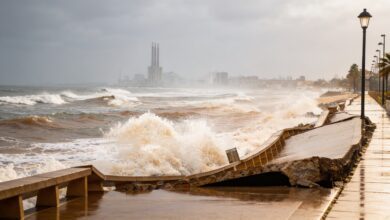
While residents tried to figure out the alerts, Storm Harry continued its onslaught. Torrential rains, gale-force winds, and powerful waves battered the coast. Landslides occurred in some areas, forcing local authorities to urgently close roads and evacuate people from danger zones. The streets were filled with tension: some rushed home, others tried to reach family members by phone, while some simply watched the raging storm from their windows.
Authorities urged people to stay calm and follow instructions, but the confusion over the alerts only fueled anxiety. Many wondered if they could trust the system, especially when even the message headlines led to more questions. Nevertheless, most chose not to take chances and stayed home, tracking developments on their phones.
European standards
The introduction of the Es-Alert system became mandatory for all EU countries in 2022. Spain was among the first to implement it, aiming to quickly inform citizens about emergencies. This involved not only regional coordination centers but also the country’s largest mobile operators. However, as the situation with Storm Harry revealed, even the most advanced technologies are not immune to failures and shortcomings.
While engineers and officials argue about what caused the confusion, Catalonia’s residents remain divided over what matters most: the accuracy of alerts or the speed at which they’re delivered. One thing is clear — when nature shows no mercy, even minor miscommunication can prove costly.