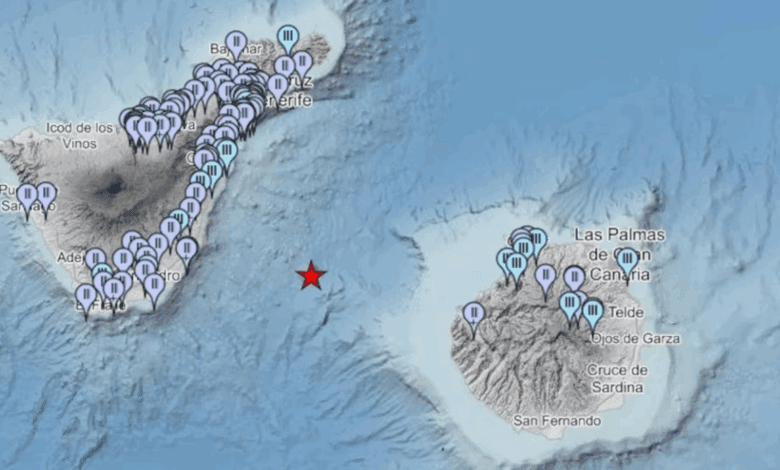
On Thursday afternoon, residents of the Canary Islands experienced an unexpected seismic event, once again highlighting the region’s natural risks. An earthquake with a magnitude of 4.1, recorded between Tenerife and Gran Canaria, was felt across numerous municipalities on both islands. The incident sparked discussion among experts and locals, as such tremors can impact daily life and infrastructure.
According to El Pais, the seismic tremor was registered at 12:26 p.m., followed ten minutes later by a minor aftershock with a magnitude of 2. The epicenter was located at a depth of about 10 kilometers, which is typical for events of this kind in the area. Reports of ground vibrations came from various cities, including Arico, La Laguna, Santa Cruz, Arafo, Los Realejos, Guimar, La Matanza, Candelaria, La Orotava, La Esperanza, El Rosario, Tacoronte, Arona, Granadilla, and Santa Ursula on Tenerife, as well as Gáldar, Agaete, La Aldea, Vega de San Mateo, and Valsequillo on Gran Canaria.
Seismic Activity
The area where the tremor occurred is known as the Enmedio volcano zone (Enmedio), considered the most seismically active region in the Canary Islands. Despite its name, experts emphasize that the current activity is not related to volcanism, but rather to the distinctive geological structure of the seabed between the islands. Each year, 400 to 500 earthquakes of varying strength are recorded here, although only a few are strong enough to be felt.
The intensity of the latest event was rated at level III, with isolated peaks reaching IV on the scale, indicating a noticeable impact on people and objects but without causing significant destruction. It’s important to note that such tremors can cause concern among the population, especially in densely built-up areas with extensive infrastructure.
Response and consequences
Local authorities and emergency services are closely monitoring the situation. According to El Pais, there have been no reports of injuries or significant damage. However, experts continue to observe and provide timely updates to the public about any changes. A surge in discussions on social media and local forums shows that island residents take such events seriously, despite their frequency.
Experts point out that such earthquakes are part of the natural processes affecting the Canary Islands archipelago. Regular measurements and data analysis allow for timely identification of potential threats and help minimize risks for the population. In recent years, alert and monitoring systems have been significantly improved, which has enhanced safety levels.
Historical context
The area between Tenerife and Gran Canaria has repeatedly become the epicenter of notable seismic events. In May 1989, one of the strongest earthquakes of the past fifty years occurred here, with a magnitude of 5.2, felt on both islands. Since then, experts have paid special attention to this region, pointing out its unique geological features.
In recent years, the Canary Islands have regularly experienced minor tremors; however, most go unnoticed by residents. Only certain incidents, like the current one, spark public discussion and become a topic of debate. According to RUSSPAIN.com, modern technology enables rapid detection and analysis of such phenomena, which helps authorities respond promptly to potential threats.
Recalling recent cases, it is worth mentioning that similar magnitude earthquakes were recorded in the same area in 2023 and 2024, but they did not lead to serious consequences. Monitoring systems continue to improve, and island residents are learning to respond calmly and consciously to such events. Overall, regular seismic tremors have become part of life in the Canaries, shaping a distinctive attitude toward natural phenomena and strengthening safety culture.