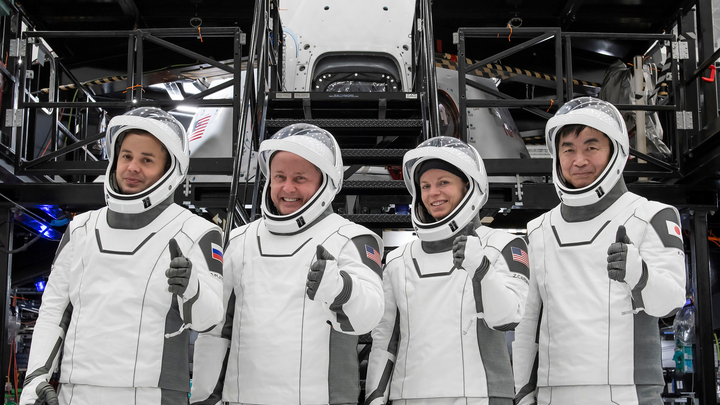
The International Space Station (ISS) is preparing to operate with a minimal crew. In early January 2026, NASA decided to bring four astronauts from the Crew-11 mission, launched to orbit by SpaceX, back to Earth ahead of schedule. The reason was a sudden medical issue affecting one of the crew members. The astronaut’s name has not been disclosed, but it is known that the situation was not related to preparations for a spacewalk, which had been scheduled for January 8 and was canceled at the last minute.
Only three people now remain aboard the ISS: Christopher Williams from NASA, as well as Sergey Kud-Sverchkov and Sergey Mikaev, representing the Russian space agency Roscosmos. While this is not the station’s first experience operating with such a reduced crew, the current circumstances add pressure: Crew-11 was originally scheduled to remain on orbit until mid-February, when the arrival of the next crew rotation was expected.
Limited capabilities
With Crew-11’s departure, the responsibility for maintaining the station’s operations now rests with the remaining astronauts. Williams will be solely responsible for managing the American segment of the ISS, but NASA assures that he is fully trained and capable of handling all tasks. He is supported by mission control teams around the world, as well as commercial partners overseeing scientific experiments.
Russian cosmonauts Kud-Sverchkov and Mikaev arrived at the station together with Williams in November 2025 aboard the Soyuz spacecraft. They can assist with American systems, although their main responsibility is the Russian segment. If necessary, they join efforts to handle safety issues and equipment maintenance.
Science on hold
Reducing the crew to three will inevitably impact the ISS scientific program. Many experiments require several specialists, and extravehicular activities—spacewalks—become impossible, as at least two astronauts are needed for those tasks. In the coming weeks, the station will operate in maintenance rather than development mode.
Moreover, a smaller crew means greater risks in emergencies. If there’s a technical failure or urgent repairs are needed, there will be fewer resources and less time to respond. Nonetheless, NASA and Roscosmos emphasize that all major station systems remain under control and crew safety is the top priority.
An unexpected challenge
A medical issue affecting a Crew-11 member caught the entire mission team off guard. NASA has not disclosed details, citing medical confidentiality, but says the decision to bring the crew home early was made solely for safety reasons. Specialists on Earth have better diagnostic and treatment options than are available in orbit.
It is still unclear how long the ISS will operate with a ‘skeleton crew.’ If the Crew-12 launch takes place earlier than scheduled, this period of limited capability could be reduced to just a few weeks. Otherwise, the three remaining crew members will face the challenge of isolation and a much heavier workload.
Looking back
A situation where only three people remain on the station is not new for the ISS. In the early years of operation, that was the standard crew size. However, with growing international cooperation and an increasing number of scientific programs, crews expanded. Returning to the minimum number of astronauts is a necessary measure, but not a disaster.
There have already been times in ISS history when technical or logistical issues forced the station to operate with a limited presence. Each time, the crew managed to overcome the difficulties, although the workload for each member surged. What makes the current situation more complicated is that Crew-11 was originally supposed to be replaced only in mid-February, but now the rotation schedule may change.
RUSSPAIN reminds readers that the International Space Station is the largest joint project of NASA, Roscosmos, the European Space Agency, as well as Japan and Canada. The station has been orbiting since 1998, and its crews change every few months. Over the years, the ISS has become a unique laboratory for research in microgravity and a symbol of international cooperation in space.