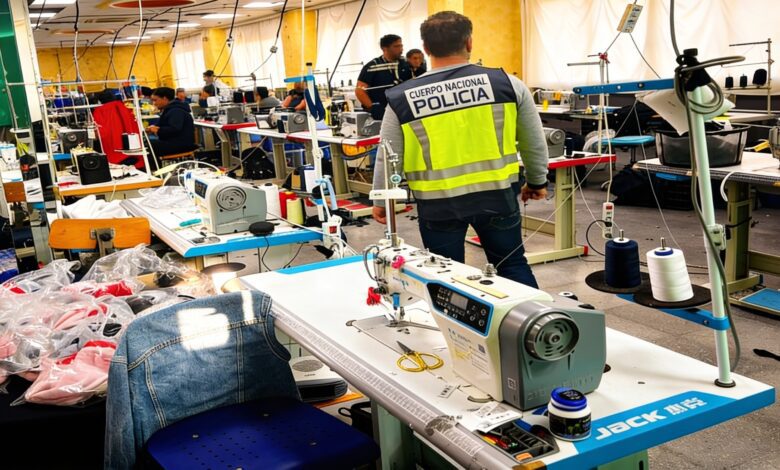
The uncovering of an underground textile factory in Valencia once again raises concerns about the scale of illegal employment and migrant exploitation in Spain. For local residents, it serves not only as an alarming signal of labor rights violations but also highlights how such schemes impact the region’s economy and labor market conditions. The case in Camp de Túria shows that even after tightening controls, these enterprises continue to operate, undermining trust in the system and posing risks to social stability.
Police operation
Officers from the National Police have carried out a large-scale operation in one of the towns of Camp de Túria, where an illegal clothing workshop was uncovered. According to El Pais, 26 people were working there, 24 of whom did not have legal status in the country. None of the workers had official contracts or were registered in the social security system. Two men, aged 44 and 52, have been arrested on suspicion of violating workers’ rights, with one also facing charges of unlawful labor trafficking and breach of judicial restrictions.
The investigation began after a joint inspection by the police and labor authorities in October 2025. During the visit, it was revealed that the workshop was operating without a license, with employees producing clothing for various companies without any guarantees or legal protection. Two workers were living directly on the premises in unsanitary conditions, allowing the organizers to keep production running nonstop.
Exploitation scheme
The investigation revealed that workers were forced to work 60 or more hours a week, earning around 1,000 euros a month. All payments were made outside the framework of current legislation. A specially equipped van transported employees from the suburbs of Valencia, delivering finished products to customers as well.
The organizers set up a complex corporate structure: officially, operations ran through a commercial company that invoiced other firms, creating an illusion of legality. Some of the assets were registered to relatives of the main suspect to make it harder to trace the real owners. In eight months, over 300,000 euros from clients passed through the company’s accounts.
Continuation of operations
After the first inspection, the workshop was sealed, but soon police discovered production had resumed at the same location. In February 2026, a repeat inspection confirmed that the main figure continued managing the process and accepting new orders. As a result, both suspects were detained, one faced additional charges, and the other was released on the condition to appear in court.
As El Pais notes, such schemes not only violate workers’ rights but also distort market competition. While legal businesses are required to comply with all regulations, underground workshops gain an advantage by saving on wages and taxes. This poses a threat to the sustainable development of the sector and social protection.
Context and consequences
In recent years, Spain has faced a rise in illegal employment, especially in sectors where manual labor is in high demand. According to RUSSPAIN.COM, such incidents are becoming increasingly common amid migration flows and economic challenges. The country has recently debated the risks associated with mass legalization of migrants and the release of members of radical groups — details on new security and social challenges.
Such investigations have surged not only in Valencia but also in other regions across the country. Over the past two years, police have repeatedly uncovered underground factories in Catalonia and Andalusia, where undocumented migrants were also exploited. In most cases, organizers used complex schemes to conceal income and avoid liability. Authorities continue to ramp up controls, but the problem remains pressing and calls for comprehensive legislation and interagency cooperation.