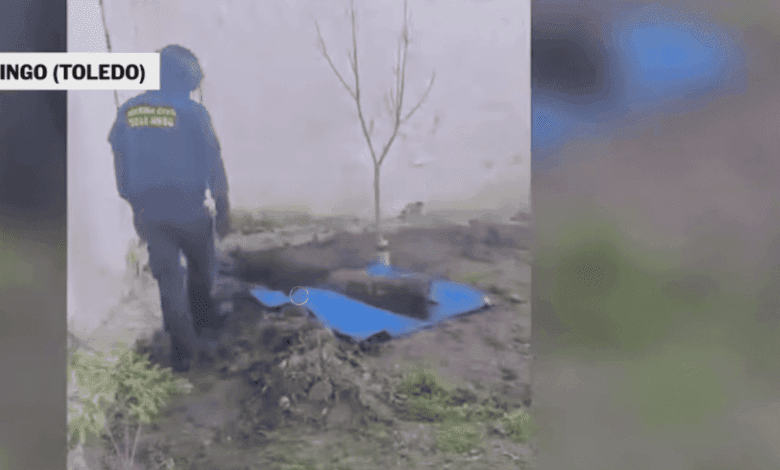
In Val-de-Santo-Domingo (Toledo), an ordinary Sunday suddenly turned into a day of alarm and memories of Spain’s tragic history. A local resident, while planting a tree in his yard, came across a metallic object that turned out to be an aerial bomb from the Civil War era. This event not only disrupted the daily life of the small community but also served as a stark reminder of how the past can resurface unexpectedly in the most unlikely places.
According to El Pais, the discovery was made on Pancique Street. The homeowner, noticing a suspicious cylinder with remnants of earth and distinctive tail fins, decided not to take any chances and immediately contacted the Guardia Civil. Overnight, the site was guarded by police officers, and the next morning bomb disposal experts from the Gedex unit joined the operation. They established a 200-meter safety perimeter around the house and evacuated residents from nearby homes.
Bomb disposal operation
Gedex specialists spent several hours on site to safely extract and transport the hazardous item. An old landfill on the outskirts of the village was chosen for the bomb’s disposal. According to the mayor of Val-de-Santo-Domingo, the operation took longer than expected: the first detonation attempt failed, and only on the second try was the explosive device destroyed. Firefighters from Santa Olalla and a medical team were also involved in case of emergency.
Local residents, watching the events unfold, at first didn’t believe the threat was real. Many thought it was a prank until they saw the police cordon and special equipment. Despite some nervousness, there was no panic—rather, surprise and speculation about how such an artifact could have remained underground for nearly 90 years.
Historical background
As reported by El Pais, until that day, the municipality was not widely aware of the bombings during the war years. However, after the incident, city hall obtained material confirming that on September 12, 1936, an air raid did take place in Val-de-Santo-Domingo, resulting in casualties among the local residents. Historians link these events to the advance of Francoist troops after the Battle of Talavera and attempts by the air force to force the population to surrender.
According to a history professor at the University of Castilla-La Mancha, the planes likely took off from an airfield in Navalmoral de la Mata (Cáceres). Although not all details have been confirmed, it is known that German-made munitions were used and that the incident was part of large-scale military operations in the region.
Memory of the war
The incident in Val-de-Santo-Domingo serves as a reminder that traces of war can persist for decades, remaining unnoticed in the most ordinary places. Such discoveries are not uncommon in Spain: in recent years, unexploded shells and mines from the Civil War or World War II have been periodically found in various regions of the country. Each case sparks public discussion, renews interest in history, and highlights the need for caution during excavation work.
In 2024, a similar incident occurred near Madrid, where construction workers unearthed an artillery shell while building a road. In 2025, a mine was discovered on farmland in Catalonia, which also had to be destroyed on site. These events demonstrate that even decades after the end of armed conflicts, their consequences can unexpectedly resurface, demanding attention and professional intervention.