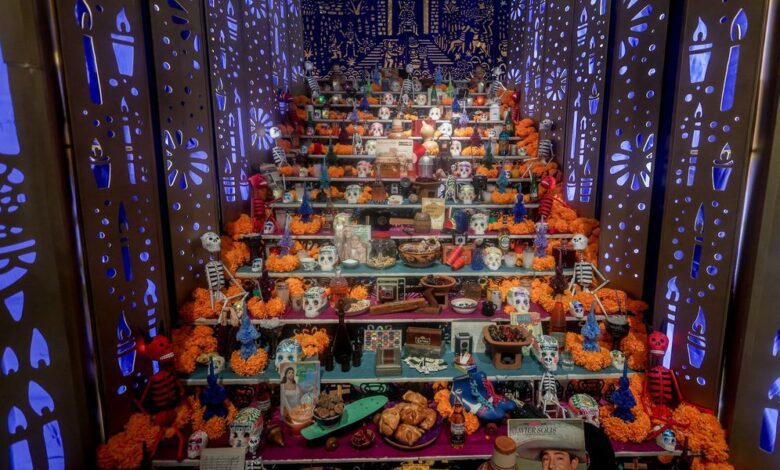
In the very heart of the Spanish capital, one of Mexico’s most vibrant traditions comes to life once again. On Alberto Aguilera Street, 20, inside the Fundación Casa de México building, visitors are greeted by an altar unlike any other. Here, among feathered Catrinas, sugar skulls, and the scent of pan de muerto, locals and tourists alike can feel as though they’ve stepped into the world of ‘Coco’—only for real.
This year, the organizers aimed to surprise the public: the altar is styled as a cabaret, transporting visitors to the atmosphere of early 20th-century Mexico City. The installation was inspired by legendary venues that once featured iconic stars such as Jesusa Rodríguez and Tito Vasconcelos. The project was designed by architect and designer Guillermo González, with contributions from Andrés Medina, Luis Ech. Muñoz, and Arlette Salas. At the center are full-sized papier-mâché Catrina showgirls, glass spheres, and an entire wall of acrylic skulls, evoking the ancient tzompantli traditions.
Admission to the exhibition is free, but exclusive tours require prior registration. Every corner of the altar is rich in detail: photos of the departed, favorite dishes, flowers, and personal belongings remind visitors of those who have already moved on to Mictlán—the mythical underworld. The atmosphere is unique: it feels as if the boundary between worlds grows thinner and the memory of ancestors shines brighter.
The Day of the Dead celebration in Mexico is not just about family dinners and decorated streets, but a true kaleidoscope of cultural influences. On this day, ancient Maya and Aztec rituals come to life, and modern traditions intertwine with history. In Madrid, despite being thousands of kilometers from Mexico, this spirit has been captured: music fills the air, masks sparkle, and the scent of flowers and sweets lingers everywhere. For many locals, this is more than just an exhibition—it’s a chance to experience another culture and reflect on their own roots.