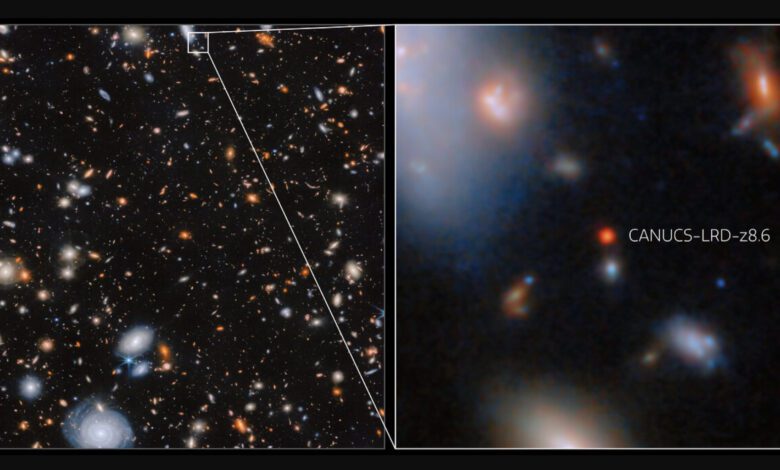
Unexpected discovery in the depths of space
An international team of researchers led by Roberta Tripodi from the University of Ljubljana has been observing the galaxy CANUCS-LRD-z8.6, located at a vast distance from Earth. Light from this galaxy has traveled 13.3 billion light-years to reach modern telescopes. The galaxy dates back to the era of reionization—a period when the Universe was just beginning to form its first stars and galaxies.
At the center of CANUCS-LRD-z8.6, scientists discovered a supermassive black hole with a mass exceeding 100 million times that of the Sun. This value is dozens of times greater than predicted by existing models for such an early stage in the evolution of the cosmos. Objects like this had never been observed before in such young and compact galaxies.
Analysis of the galaxy and black hole properties
CANUCS-LRD-z8.6 is much smaller than the Milky Way, but its star formation rate is remarkable: about 50 new stars are born here every year, which is unusual for such a young system. Spectral studies show that the gas temperature inside the galaxy reaches nearly 40,000 degrees Celsius, while the heavy element content is extremely low—less than one-fifth of the Sun’s level.
These findings indicate that the galaxy’s chemical composition has remained virtually unchanged since its formation. The stars are only beginning to enrich the surrounding space with metals, and the system itself retains the characteristics of the primordial Universe. The core’s activity cannot be explained solely by star formation processes, pointing to a powerful influence from the central black hole.
Hypotheses on the Origin of the Giant Object
Astronomers believe that the rapid formation of the supermassive black hole is linked to unusual conditions in the early Universe. It likely did not result from the collapse of a massive star, but rather from the direct collapse of a huge gas cloud. This scenario helps explain how the black hole could accumulate a mass exceeding 100 million solar masses in such a short period.
Calculations show that this object could have absorbed matter at a rate far exceeding the so-called Eddington limit—the theoretical boundary for the stable growth of black holes. This discovery challenges previous assumptions about the evolution rates of similar objects in the early Universe.
Impact of the Discovery on Modern Cosmological Theories
The discovery of such a massive black hole in a young galaxy supports the hypothesis that in the first hundreds of millions of years after the Big Bang, black holes could have formed and grown more rapidly than the surrounding star systems. This opens new opportunities for studying the processes that took place during the epoch of reionization and prompts a reassessment of existing models for the evolution of galaxies and quasars.
Scientists believe that such objects could have served as the foundation for the formation of the brightest and most massive quasars observed in later epochs. The new data will help refine our understanding of how supermassive black holes form and clarify their impact on the development of their surroundings in the early universe.
In case you didn’t know: What we know about the James Webb Space Telescope
Recall that the James Webb Space Telescope (JWST) is the largest and most advanced astronomical instrument ever launched into space. Its development took more than two decades, and it was launched in December 2021. The telescope was built by an international consortium including NASA, the European Space Agency (ESA), and the Canadian Space Agency (CSA). The main mission of Webb is to study the most distant and ancient objects in the universe, including the first galaxies, stars, and black holes. Thanks to its unique infrared optics, JWST can peer through dense clouds of dust and capture light reaching us from the dawn of the cosmos. In a short period of operation, the telescope has already made a series of groundbreaking discoveries, giving scientists a new perspective on the processes of galaxy formation and the evolution of the universe. Its data are used to refine cosmological models and to search for fundamental answers about the origin of matter and the structure of the cosmos. JWST continues to broaden the horizons of astronomy, revealing new mysteries and showcasing the uniqueness of every discovered object.