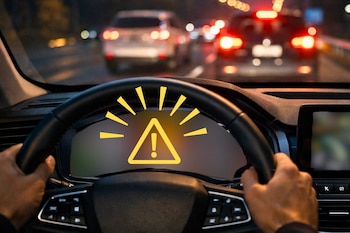
Spanish drivers are facing an unexpected change in road safety regulations. The familiar physical triangles and even the V16 beacon are being replaced by a digital revolution. The introduction of the virtual V27 signal is set to transform how road hazards are communicated, though not for every motorist. The new system has already sparked lively debate among experts and the general public.
The essence of the innovation is straightforward: previously, when there was an accident or breakdown, drivers would place a physical warning triangle on the road, and since 2024, the V16 light beacon became mandatory. Now, there is an additional level — the digital one. There is no need to buy, store in the trunk, or set up V27 on the roadside. This signal doesn’t exist in the physical world — it only appears on the screens of modern cars connected to telematics systems.
How the V27 works
When an accident or breakdown occurs, the driver activates the V16 beacon. This device automatically sends the incident’s coordinates to the national road traffic platform. The system then generates a digital warning — the V27 — which instantly appears on the dashboards of vehicles traveling along that route. Drivers receive information about the obstacle in advance, before they can even see it themselves.
However, only owners of new cars equipped with modern communication systems will be able to take advantage of this digital warning. Older vehicles, which make up the majority on Spain’s roads, will be left out of this innovation. This has already sparked a wave of criticism, with the gap between drivers becoming even more apparent.
Advantages and limitations
The main advantage of V27 is the speed of information transfer. Drivers receive real-time alerts about road obstacles, helping reduce the risk of accidents and traffic jams. However, there is a downside: if the car does not support connection to the national platform, the V27 signal will remain invisible to it. Therefore, the system only works for part of the country’s vehicle fleet.
The Ministry of the Interior emphasizes that V27 is not a replacement for the V16 beacon, but merely an additional tool. The light beacon remains mandatory for everyone, regardless of the car’s age or presence of digital systems. The virtual triangle is a step toward the future, but does not abolish existing rules.
Technology and accessibility
The rollout of V27 highlights the divide between new and old vehicles. Only cars able to receive data via telematics platforms will benefit from the digital signal. For other drivers, nothing will change: they must still use the V16 beacon and follow familiar instructions.
Experts note that the main beneficiaries of the new initiative will be owners of modern cars equipped with advanced communication systems. For most Spaniards, whose vehicles are far from technological innovations, V27 will remain out of reach. This creates a new divide on the country’s roads.
The future of road safety
The arrival of V27 is not only a technological breakthrough, but also a reason to reflect on the future of road safety. On one hand, digital signals enable faster responses to dangers. On the other, they highlight the technological disparity among drivers. In the coming years, Spain will likely face the need to upgrade its vehicle fleet and further digitalize its road infrastructure.
For now, the virtual triangle remains a voluntary and free addition to existing safety measures. Its effectiveness depends directly on how quickly drivers adopt new technology. Meanwhile, old and new systems continue to coexist on Spain’s roads, and each driver decides how best to protect themselves and those around them.