The sharp rise of Vox in Aragon’s municipalities has become one of the most noteworthy political events in recent years. For local residents, this means not only a change of leadership in dozens of towns, but also potential shifts in social and migration policy. The impact is particularly strong in the province of Teruel and in communities with a high percentage of foreigners, where the party achieved record results.
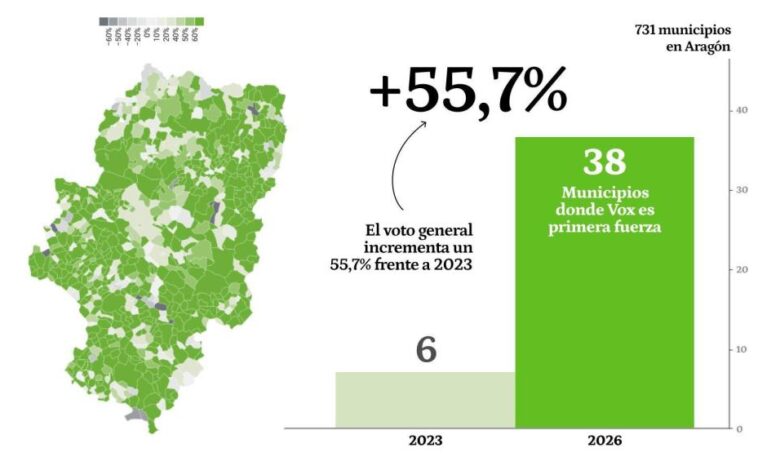
In this electoral cycle, Vox increased its support by 55.7% compared to the previous year. The party secured 54% of the votes in provincial capitals where migrants make up more than 15% of the population. Overall, Vox won in 38 municipalities—six times more than the year before. The growth is especially notable in Teruel, where the party established leadership in most cities new to its platform.
Redistribution of power
Following the latest elections, Vox took 21 municipalities from the People’s Party (PP), 7 from the Socialists (PSOE), and 4 from the regional PAR. In some cases, the party managed to overtake coalitions that previously united PP and PSOE or PAR and PSOE. In one municipality, Vox took over a seat formerly held by the Existe coalition. This points to a profound change in the region’s political preferences.
In 669 out of 731 Aragonese municipalities, the party increased its share of the vote. This broad growth led to a noticeable shift of the region’s political landscape to the right. The strategy of Jorge Azcón, former head of Aragon, to call early elections unexpectedly benefitted Vox rather than his own party.
The geography of success
In Zaragoza, Vox received 15,244 votes, in Teruel — 1,737, and in Huesca — 1,638. These three cities accounted for more than half of the party’s total result, but Vox’s successes were not limited to major centers. More than 50% of the new municipalities where the party won are located in the province of Teruel. In 2023, Vox won in only six municipalities, but now that number has risen to 38.
In the previous elections, the party ranked second in 9.16% of municipalities, but now this figure has increased to 20%. Vox also solidified its third-place position, raising its share from 43% to 51% of municipalities.
Municipalities and migration
Veguillas de la Sierra in Teruel set a record for Vox support — 65% of voters backed the party, even though foreigners make up 11% of the population. In Almohaja, where there are no migrants at all, Vox’s support reached nearly 60%. In Santa Cruz de Nogueras and Alpeñés, the party also garnered over half the votes, with the latter city having a migrant population of 15%.
Only 12 municipalities did not give Vox a single vote. Among them are Cerveruel and Lobera de Onsella in Zaragoza, where PSOE was victorious. In Olvena, the party increased its share from 8% to 47%, and in Vinaceite — from 4.4% to 23.8%.
Trends in other regions
In Huesca, Vox has notably strengthened its position in municipalities with a high proportion of migrants. In Fraga, the party nearly doubled its results, showing a 94% increase. In Caspe, its share of the vote also doubled. However, the trend was not positive everywhere: in Embid de Ariza in Zaragoza, support for Vox fell from 63% to 19%, ceding leadership to the Socialists. In Seira and Valacloche in Teruel, the party also lost part of its electorate.
Overall, Vox reinforced its position in 669 out of 731 municipalities, reflecting a significant shift in the region’s political sentiment. Only in a few cities did voters return to supporting PSOE or PP, but such cases were rare.
In recent years, Spain has seen sharp shifts in the regional political balance more than once. Similar changes have already occurred in Andalusia and Castilla-La Mancha, where new parties quickly gained momentum amid growing discontent with the traditional powers. Migration trends and economic hardships have often served as catalysts for the rise of radical movements. As a result, the country’s political landscape is becoming increasingly diverse, and voter preferences are less predictable.