Spain is once again debating how art can influence the perception of its own history. The opening of a major exhibition of Ferrer Dalmau’s works in Valladolid has prompted a rethinking of national memory. His paintings not only revive forgotten episodes but also offer a new perspective on the country’s past, bridging generations.
The Comeback of Battle Painting
At the start of the 21st century, the genre of battle painting in Spain had nearly vanished. The name José Cusachs was known only to a handful of experts, and interest in military history was reflected more in books than on canvas. Ferrer Dalmau was one of the few who set out to fill this gap. His works quickly captured the public’s attention, demonstrating that visual interpretations of history are still in demand today.
The artist notes that Spaniards lacked images to visualize their own past. Unlike American history, where Hollywood has created an entire gallery of recognizable faces and scenes, Spanish history remained faceless. Dalmau set himself the task of giving Spaniards the chance to see their heroes — their emotions, gestures, and even their defeats.
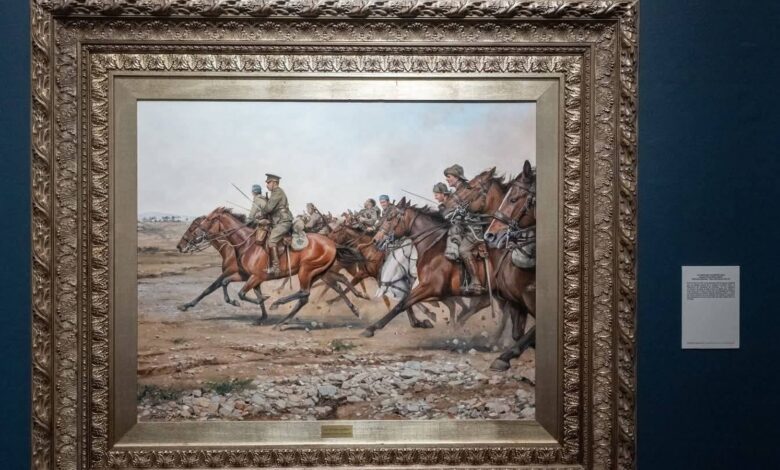
His approach is based on meticulous attention to detail. Every element — from weaponry to the color of uniforms — is verified by experts. Even the dust and mud on the roads in his paintings are as true to life as possible. This level of authenticity has become his trademark and has earned him recognition not only in Spain but abroad as well.
Facing War
A distinctive feature of Ferrer Dalmau’s work is his personal participation in military missions. He doesn’t limit himself to archives and photographs; instead, he travels to hotspots to experience the atmosphere of battle firsthand. The artist has accompanied Spanish and foreign troops into conflict zones, observing soldiers closely and capturing their facial expressions, movements, and gestures—details that later become the foundation of his paintings.
Dalmau is convinced: it is impossible to depict a battle without understanding what a person feels on the battlefield. His paintings are filled with tension, anxiety, inner strength—the kind of emotions that can only be conveyed through personal experience. Sometimes his canvases feature the recognizable faces of modern soldiers placed within historical scenes. This creative approach adds a special relevance and depth to his works.
The exhibition in Valladolid features both anonymous faces and easily recognizable figures. For example, in the painting ‘The Conquest of Oran’ (La conquista de Orán), the features of well-known contemporaries can be seen among the soldiers. Such techniques bring the past and present closer together, making history more accessible and understandable to the viewer.
Historical episodes on canvas
The exhibition ‘Images of History’ (Imágenes de la historia) presents 17 original works and 14 high-quality reproductions. The paintings bring to life key moments in Spanish history: the Battle of Las Navas de Tolosa, El Cid’s encounter with a child, Columbus’s landing in America, Hernán Cortés’s entry into Tenochtitlán, the defeat of the tercios at Rocroi, episodes of the War of Independence, and Spain’s support of American colonists against England.
A special place is given to scenes from the Carlist Wars—one of the artist’s favorite subjects. Dalmau admits he is drawn not only to the drama of the events, but also to the aesthetics: vivid uniforms, battle berets, the atmosphere of doom and heroism. In his paintings, defeat carries as much weight as victory, and the faces of the vanquished are filled with dignity and inner strength.
Attention to detail and emotional depth make each painting a story in itself. The viewer is not just observing history but becomes part of it, experiencing the tension and drama of the events.
Technique and inspiration
Ferrer Dalmau is known not only as a battle painter but also as a master of depicting horses. Experts and audiences alike praise his ability to convey the dynamism and character of these animals. The artist attributes this to his lifelong fondness for horses. Even after an injury prevented him from riding, he continues to draw inspiration from memories and the scent of stables.
Dalmau’s interest in military themes began in childhood. He was fascinated by comics, adventure and war films, and played with toy soldiers. This hobby turned into a career when he realized he could share his impressions through painting. His works appeal not only to history enthusiasts but also to a broader public.
Over time, society’s attitude toward the military has changed. While the army was once viewed with caution, today it has become part of the national identity. Dalmau’s paintings contribute to this process by showing that the history of the army is the history of the country.
New horizons
In recent years, the artist has been actively involved in education. He founded his own school to pass on his experience to young artists and continue the tradition of historical painting. Dalmau admits there is still much work to do: many important episodes in Spanish history have yet to find visual representation.
Creating historical canvases requires not only talent, but also deep knowledge. Dalmau’s studio employs entire teams of historians and experts who help recreate the smallest details of each era. This approach makes his works unique and in high demand.
Interestingly, some unexpected figures have appeared among the artist’s students — for example, a well-known caricaturist who created his own version of one of the famous battles. This demonstrates that the genre continues to evolve and attract new creators.
In recent years, Spain has seen a growing interest in historical reenactments and exhibitions dedicated to its military past. Festivals are held in various cities, recreating battles and showcasing vintage costumes and weaponry. These events attract thousands of spectators and have become an important part of cultural life. New museums devoted to military history are opening, while artists and photographers increasingly turn to this theme. This demonstrates that interest in the past is not fading but, on the contrary, is becoming ever more relevant for today’s society.