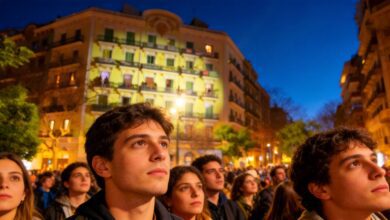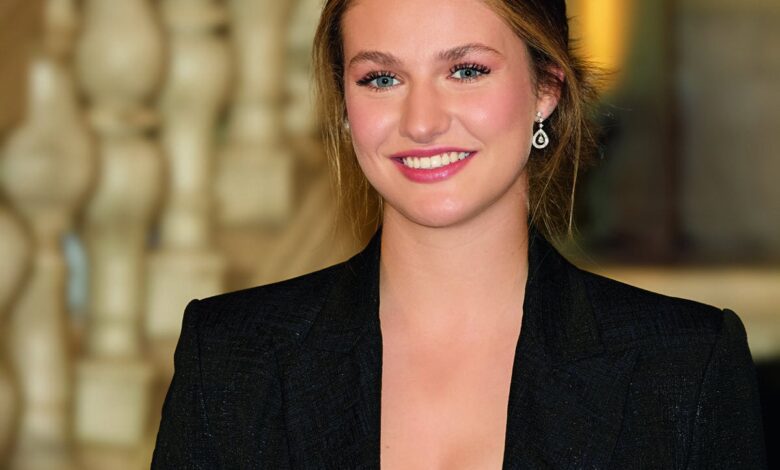
Cries of “¡Viva la princesa!” and a sea of raised phones have become a familiar backdrop to any public appearance of the Spanish crown princess. On July 14 in Marín, Galicia, where she arrived after receiving an honorary medal, another scene of widespread adoration played out. Dozens of people pressed against barricades chanted her name, hoping to catch her eye or a brief touch. This phenomenon, which journalists have dubbed “Leonormania,” has been gaining momentum every year. On October 31, the princess turns twenty, making it a fitting moment to take a closer look at the young woman destined one day to lead the nation.
In recent months, we have closely followed her public appearances, witnessing how she gradually gains confidence and spreads her wings. In Galicia, dressed in the Navy’s immaculate white uniform, she displayed remarkable closeness to the people. Breaking protocol, the princess even knelt down to take a selfie with a little girl. Leonor almost always smiles, but speaks little. She bears the immense burden of historical responsibility, and she seems fully aware of it. “Service, commitment, and duty”—the three principles inherited from her father, King Felipe VI—have become a kind of mantra for her in moments of doubt. Up close, her face appears almost porcelain, while her piercing blue eyes and perfectly styled hair create an air of understated elegance. She is still a bit shy in front of photographers, but the click of shutters follows her every move.
Three branches: the path through the army, navy, and air force
On September 1, the heir to the throne began her studies at the Air Force Academy in Murcia, where she will learn to fly. This followed an almost five-month voyage across the Atlantic and Pacific Oceans aboard the training ship Juan Sebastián Elcano. When the vessel returned to port, none of the royal family members were there to greet her. It was a different story in May 2025, when the ship docked in Panama. Then, Queen Letizia, unable to contain her motherly feelings, flew in to hug her daughter and waited for her on the pier alongside the families of other cadets. The Queen finds it difficult to cope with being separated from her daughters. While Leonor was at sea, her younger sister, Infanta Sofía, was finishing her bachelor’s degree in Wales and later enrolled at Forward College under the University of London to study political science. She is set to study in Lisbon, Paris, and Berlin. Those close to the Queen admit that adjusting to an empty nest has not been easy for Her Majesty.
Beyond palace walls: family, education, and the future
The days when both princesses were carefully shielded from public attention are long gone. Queen Letizia did everything possible to protect her daughters’ private lives, but now they have stepped out of the shadows. Journalist José Antonio Zarzalejos, author of King Felipe VI’s biography, highly values the queen’s role in shaping the heiress. He considers her influence overwhelmingly positive, noting that she approached the formation of the future queen’s character with utmost responsibility. But what do Spaniards themselves know about the one who will become their queen? Analysts agree that Leonor’s main strength lies in her pleasant personality, open smile, and receptiveness.
Carmen Remírez de Ganuza, author of the first biography of the princess, holds a slightly different view. She believes the heiress is still in a kind of “cocoon,” and her main asset for now is the absence of any serious mistakes. The only misstep might be the old incident in Palma with her grandmother, Queen Sofía, but everyone has already forgotten about it. According to her, this is now a favorable time for Leonor: the monarchy, despite political turbulence, remains one of the healthiest institutions in the country. Her military training, which seemed unusual at first for a demilitarized society, has turned out to be her best investment in the future. She is responsible, disciplined, and sociable. The only thing she might lack is a certain “chemistry” with ordinary people—a closer, more informal connection.
Speaking of flying, by entering the Air Force Academy, Leonor has become the first Princess of Asturias in history to train as a pilot. This marks an important step in her military career, one that will eventually lead her to the title of supreme commander-in-chief. Reports suggest that she might complete her first solo flight by Christmas. For now, she faces a strict routine: wake-up at 6:30, classes until six in the evening, and lights out at 22:30 in a room shared with three roommates. The next likely step is university, which also remains a subject of debate. Should she pursue a full degree, as her father did when he studied law, or would it be better to focus on in-depth study of key disciplines such as constitutional law, history, art, and digital technologies? After all, her role will not be to govern, but to represent Spain on the world stage.
Challenges for the 21st Century Monarchy
What is beyond question is her oratory skill. Every word in her speeches is carefully chosen and precise. She speaks with restraint, calm, and confidence, showing an increasing ease with public communication year after year. Those close to the family note the remarkable bond between the sisters. It is said that Infanta Sofía knows Leonor’s speeches better than the princess herself. For security reasons, they always travel on different airplanes, and every separation, even for a 40-minute flight, is marked by touching farewells. Sofía, who grew up without the burden of succession, will become her sister’s main support.
Leonor’s leadership qualities shine at the annual Princess of Asturias Awards ceremony in Oviedo. Last year, she made a strong impression with a heartfelt speech about each of the laureates, and her tribute to singer Joan Manuel Serrat, in which she quoted lines from his songs in Catalan, was especially well received. Catalonia is another challenging topic that the princess handles with great tact. She is well aware of the historical particularities of certain regions. Although support for the monarchy in Catalonia and the Basque Country is lower than the national average, Leonor is winning hearts through her actions. The Princess of Girona Awards ceremony, held in Barcelona, has become the perfect platform for the heiress to connect with Catalan society.
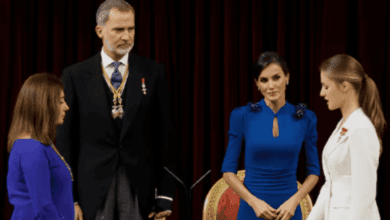
Many challenges lie ahead. These include the difficult legacy of her grandfather, King Juan Carlos, the need to protect her private life from excessive scrutiny, and the potential amendment of Article 57 of the Constitution, which still gives preference to male heirs. Yet it is already clear that Leonor is asserting herself in her role. She is ready to take up the baton and face the future. The princess’s time is coming.