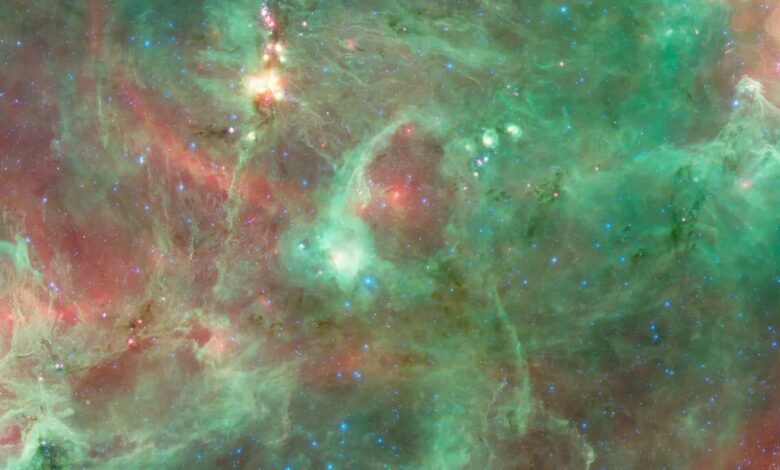
In the constellation Cygnus, astronomers have detected an unusual formation resembling a sparkling ring with a bright clump on one side. This ring, informally known as the ‘diamond ring’, is composed of gas and dust and is impressive in scale—its diameter is about 20 light-years. Scientists from the University of Cologne have published new data shedding light on the origins of this cosmic phenomenon.
To capture the image, researchers used the unique SOFIA (Stratospheric Observatory for Infrared Astronomy), equipped with a 2.7-meter telescope. The observatory was installed on a modified Boeing 747SP and flew at an altitude of over 13,000 meters—above most of Earth’s atmosphere. This allowed scientists to record infrared radiation that ground-based telescopes cannot detect.
SOFIA ended its mission in 2022, yet its collected data archive continues to yield discoveries. Using these materials, researchers examined the ring’s structure and composition in detail and determined its age—about 400,000 years, which by astronomical standards makes it a very young object.
Origin and Features of the Cosmic Ring
The ring was formed in the Cygnus X star-forming region, where dense clouds of gas and dust serve as a nursery for new stars. Unlike the typical spherical bubbles that appear around massive stars, this structure turned out to be elongated and asymmetric. The reason is that its expansion occurred inside a flat molecular cloud, resulting in a rupture and the loss of symmetry.
At the center of the ring lies the remnant of a bubble made of ionized carbon, formed under the influence of powerful radiation and stellar winds from a hot massive star. Such processes have a significant impact on the formation and evolution of cloud complexes, as well as the birth of new stars in the galaxy.
Scientists were particularly intrigued by a bright clump that visually resembles a gemstone set in a ring. However, further analysis revealed that this is actually a separate cluster of young stars located hundreds of light-years closer to Earth. This line-of-sight overlap creates the illusion of a connection with the ring, even though the objects are not physically related.
The contribution of SOFIA and the importance of this discovery
The SOFIA flying observatory made it possible to capture unique infrared images that simply cannot be obtained from Earth’s surface. Thanks to this data, astronomers were able not only to examine the structure of the ring, but also to assess its chemical composition, temperature, and dynamics of its evolution.
A study conducted by an international team led by Nicola Schneider has revealed how strongly individual stars can influence the clouds surrounding them. Such processes are crucial to understanding the mechanisms of star formation and galaxy evolution.
Scientists note that such findings offer a new perspective on the processes taking place in our Galaxy and help refine models of star cluster formation. The discovery of the ‘diamond ring’ has become a vivid example of how modern technology is expanding the horizons of astronomy.
International cooperation and research prospects
The study of the ring in Cygnus X brought together experts from various countries. Using archival SOFIA data, the team not only identified this unusual structure but also conducted a detailed analysis using advanced data processing techniques.
In the future, scientists plan to continue investigating similar structures in other regions of the Milky Way. This will help deepen our understanding of how massive stars form and destroy clouds, as well as how these processes affect the birth of new star systems.
The discovery in Cygnus X has already sparked discussion within the scientific community and will likely lead to further breakthroughs in astrophysics. Such research highlights the importance of international collaboration and data sharing between observatories and research centers.
By the way: what is SOFIA and why is it important for science
For reference, SOFIA (Stratospheric Observatory for Infrared Astronomy) is a joint project between NASA and the German Aerospace Center (DLR). The observatory was a unique combination of aviation and astronomical technology: a telescope with a 2.7-meter diameter mirror was mounted aboard a specially modified Boeing 747SP. This approach allowed the observatory to reach altitudes of up to 13,700 meters, where the atmosphere is thin and infrared radiation from cosmic objects can be detected with maximum precision.
SOFIA made its first scientific flight in 2010 and, over 12 years of operation, collected a vast trove of data that scientists around the world are still analyzing. Despite the mission ending in 2022 due to financial constraints, the observatory’s archive continues to yield new discoveries. Thanks to SOFIA, scientists detected water vapor in the Moon’s atmosphere, complex organic molecules in interstellar clouds, and many other phenomena previously beyond observation.
The project became a model of successful international collaboration and demonstrated the critical importance of innovative approaches in modern astronomy. Many of the discoveries made with SOFIA have formed the basis for new theories about star formation and galaxy evolution. Even after the mission’s conclusion, the data gathered by the observatory continues to inspire further research and new discoveries.