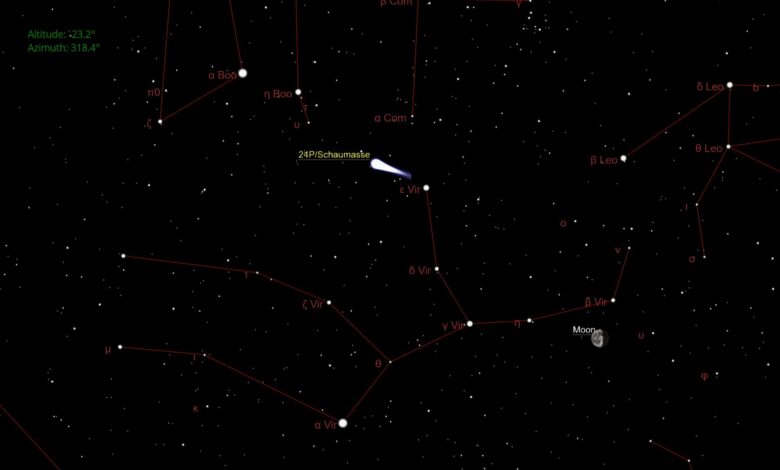
In January 2026, an astronomical event will unfold in the night sky that is sure to excite astronomy enthusiasts: comet 24P/Schaumasse will make its next close approach to the Sun, passing through its perihelion. This is not just another object in the celestial catalog, but a true veteran of the Solar System that returns roughly once every eight years. However, despite the rarity of this event, observing the comet without special equipment will not be possible—its brightness is far too faint for the naked eye.
Discovered in December 1911 by French astronomer Alexandre Schaumasse, this short-period comet travels far beyond Jupiter’s orbit before once again approaching the Sun. Each time it returns, astronomers around the world prepare their telescopes to catch a glimpse of this icy wanderer.
January close approach
This year, 24P/Schaumasse will reach perihelion on January 8, coming as close as 177 million kilometers to the Sun. At this point, the comet is heated the most, and its icy shell begins to vaporize actively, forming a gaseous coma that reflects sunlight. That’s typically when comets become brightest, sometimes even visible to the naked eye. But not this time: the current brightness of 24P/Schaumasse is around +10.8 magnitude on the visible scale, much dimmer than what the human eye can perceive (about +6.5).
For comparison: the brightest stars have a magnitude of about +1, the full Moon is minus 13, and the Sun is minus 27. So even on the darkest night, you won’t be able to spot the comet without a telescope. However, if you have a telescope with an aperture of at least 152 mm (6 inches), you may have a chance to see a faint glowing spot among the stars. Bear in mind, though, that the waning Moon will make observations more difficult by lighting up the sky during the early morning hours of January 8.
Where to find the comet
To try to spot 24P/Schaumasse, look toward the constellation Virgo, which in January rises high above the southern horizon near dawn. The best time to observe is in the early pre-dawn hours, when Virgo is already well positioned in the sky. Use the star Vindemiatrix, which has a magnitude of +2.8, as your reference point. The comet will be about five degrees to the left of this star—roughly the width of three average fingers held at arm’s length.
To help locate the object in the sky, you can use modern astronomy apps for amateurs, which can quickly orient you among the stars. In 2026, there’s a huge selection of such programs, so everyone can find a suitable option for their smartphone or tablet.
Tips for observers
If you decide to hunt for the comet, remember to prepare your telescope in advance and choose a location far from city lights. Even slight light pollution can ruin all your efforts. Don’t expect a spectacular tail or bright glow—24P/Schaumasse will remain a modest guest this time, visible only to the most persistent and patient observers.
Nevertheless, for many amateur astronomers, simply having the chance to spot a comet that has been traveling through the Solar System for over a century is an event in itself. And if you’re able to capture a photo or even catch a glimpse through the eyepiece, the experience will stay with you. Moreover, such observations help deepen our understanding of comet dynamics and evolution, and thus the history of our planetary system.
Gear and inspiration
For those just starting out in astronomy, 2026 offers a wide range of telescopes to suit any preference and budget. Modern models allow not only for comet watching but also for taking pictures you can share with astronomical communities or simply keep as a souvenir. Don’t forget to share your discoveries—perhaps your very photo will inspire someone’s future research.
And if you’re not quite ready for late-night telescope sessions, just look up at the January sky—even without a comet, it has plenty to offer. Winter constellations, bright planets, and rare celestial phenomena make each night unique. The most important thing is to remember to look up from time to time.
Comet 24P/Schaumasse was discovered in 1911 by French astronomer Alexandre Schaumasse. It belongs to the class of short-period comets, completing its orbit around the Sun approximately every eight years. Over more than a century of observations, this celestial body has repeatedly attracted the attention of both amateur and professional astronomers, with its trajectory closely monitored by international observatories.