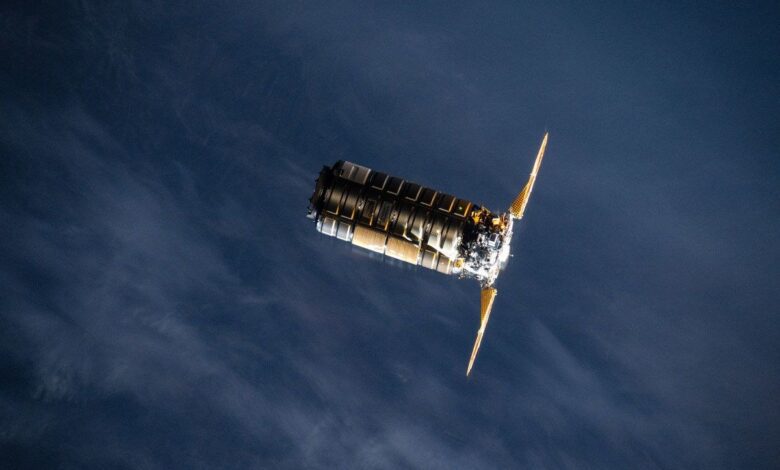
The American space agency NASA has decided to award a direct contract to Northrop Grumman for two cargo missions to the International Space Station (ISS) in 2028 and 2029. Under the current station resupply program (CRS-2), the Cygnus spacecraft will be responsible for delivering essential cargo to orbit. Financial details of the agreement have not been disclosed; however, it is known that the selection was made without an open bidding process.
This decision was prompted by a unique situation with docking ports on the ISS. At the end of the decade, one of the two available ports will be occupied by a new American spacecraft designed for deorbiting the station (USDV), which will remain attached for about a year. The other port will be needed for regular commercial crewed missions. As a result, there will be no available docking locations for SpaceX’s Dragon cargo ships.
Unlike Dragon, Cygnus uses a different method to connect to the station: instead of direct docking, it is ‘berthed’ with the help of the Canadarm2 robotic arm at a separate node. This makes it the only option for delivering cargo when access to docking ports is restricted. NASA has officially confirmed that only Northrop Grumman is capable of conducting missions through this port node, which was the decisive factor in choosing the contractor.
Cygnus spacecraft features and advantages
Cygnus offers several technical advantages that played a significant role in the decision-making process. In addition to delivering cargo, the spacecraft can incinerate waste in the atmosphere, helping to keep the station clean. Furthermore, Cygnus can participate in ISS orbit correction, which increases its value for long-term operation of the station.
In the coming years, these capabilities are expected to be especially in demand, given the plans to wind down the ISS and prepare for its deorbit. Cygnus has already proven its reliability in multiple previous missions, which also influenced NASA’s decision.
Meanwhile, the European Space Agency (ESA) is considering a contract with Northrop Grumman to deliver around five tons of payload to the ISS by 2028. This would enable ESA to fulfill its commitments for station operations. The new version of the spacecraft—Cygnus XL—fully meets these requirements and may become a cornerstone of the European supply program.
Why SpaceX’s Dragon was left out
SpaceX’s Dragon cargo spacecraft was previously used extensively to deliver supplies to the ISS. However, its design allows docking only at two specific ports, which will be occupied by other vehicles in the coming years. This eliminates the possibility of using Dragon for cargo missions in 2028–2029.
Unlike Dragon, Cygnus does not depend on these ports and can be docked to the station using a robotic arm. This flexibility makes it invaluable in situations where ISS infrastructure access is limited. NASA emphasized that there are no alternative options for completing the missions within the required timeframe.
Thus, the choice of Cygnus was driven not only by technical features but also by the current situation with docking ports on the station. This decision will ensure uninterrupted supply to the ISS at the final stage of its operation.
Cygnus XL capabilities and ESA’s plans
Cygnus XL is a new cargo spacecraft variant capable of delivering up to five tons of payload in a single flight. ESA is considering this spacecraft as its primary option to fulfill its supply commitments to the station in 2028. If a contract is signed, Cygnus XL will become the first commercial vehicle used by the European agency to deliver cargo to the ISS.
ESA’s requirements almost entirely match the capabilities of the new Cygnus version, making this spacecraft the optimal choice for the European program. A decision on the contract is expected in the coming months.
Therefore, Cygnus could become the main cargo ship not only for NASA, but also for European partners, ensuring the station’s seamless operation at the final stage of its existence.
By the way: What we know about Northrop Grumman and the Cygnus spacecraft
Northrop Grumman is one of the largest American aerospace and defense corporations, founded in 1994 following the merger of Northrop and Grumman. The company specializes in the development and production of aviation, space, and military equipment, as well as security systems. Northrop Grumman is actively involved in several key U.S. space programs, including the creation of satellites, launch vehicles, and unmanned systems.
The Cygnus spacecraft was specifically designed for delivering cargo to the ISS as part of NASA’s Commercial Resupply Services program. Cygnus made its first flight in 2013 and has successfully completed over a dozen missions since then. The spacecraft features a modular design, allowing it to be adapted for various missions and payload capacities. Cygnus is also known for its ability to eliminate waste by re-entering Earth’s atmosphere and burning up along with the trash.
Northrop Grumman continues to advance its technologies, introducing new solutions to enhance the efficiency and safety of space missions. The company works closely with NASA, ESA, and other international partners, strengthening its position in the global space services market.