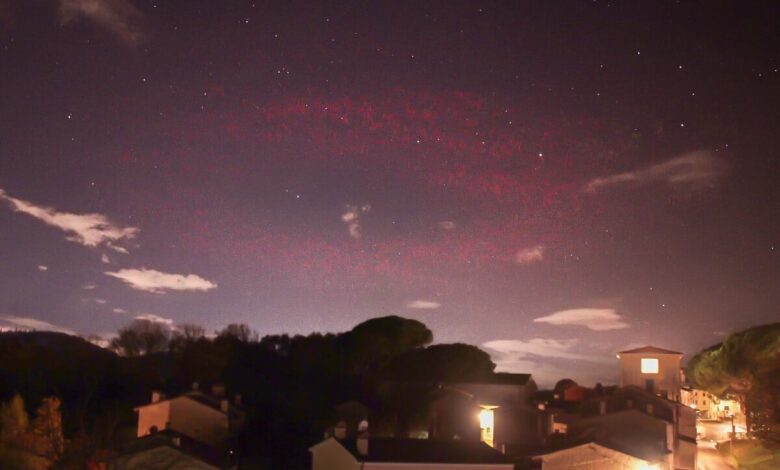
In mid-November, Valter Binotto, a resident of the small Italian town of Possagno, managed to capture on camera an extremely rare atmospheric phenomenon. From the window of his home, he witnessed and photographed a massive reddish light disc that flashed for an instant above the Alpine foothills. This phenomenon is known as an “ELVE”—a special type of upper-atmospheric lightning that appears in the high layers of the atmosphere and vanishes almost instantly.
Such flashes are extremely difficult to spot with the naked eye. They occur at altitudes over 80 kilometers and last for less than one-thousandth of a second. That’s why most people never encounter this phenomenon, and its photographs are a real rarity—even among professional weather observers and astronomers.
How ELVEs Form, and Why They’re Nearly Impossible to See
ELVEs (from the English: Emission of Light and Very Low Frequency perturbations due to Electromagnetic Pulse Sources) are rapidly expanding rings of light that can span nearly 500 kilometers in diameter. They appear high above thunderstorm clouds when a powerful electromagnetic pulse from lightning travels upward and interacts with the ionosphere—a region of the atmosphere dense with charged particles.
Unlike the familiar lightning we see during a thunderstorm, ‘elves’ are not accompanied by thunder and pose no danger to people on the ground. They can only be captured with specialized equipment capable of taking photos at extremely short exposures. Even experienced photographers rarely get the chance to record this phenomenon, as it lasts just fractions of a second and requires perfect weather conditions.
The significance of the discovery for science and observers
The photograph taken by Binotto sparked interest among atmospheric phenomena experts. Such images help scientists better understand processes occurring in the upper layers of the atmosphere and study the impact of thunderstorms on the ionosphere. Research on these flashes is crucial for forecasting space weather and assessing the effects of electromagnetic pulses on satellites and radio communications.
Although ‘elves’ were first documented only at the end of the 20th century, they are now considered one of the most mysterious and least studied types of lightning. Every new observation expands our understanding of the nature of electrical discharges in the atmosphere and their role in global climate processes.
The rarity and uniqueness of the phenomenon
Such atmospheric flashes are extremely rare and impossible to predict in advance. Even in regions with frequent thunderstorms, ‘elves’ are observed no more than a few times a year. Capturing them requires not only special cameras, but also a fortunate combination of weather conditions, time of day, and the observer’s location.
A photograph taken in Italy proved to be a true find for meteorologists and astronomy enthusiasts. It vividly demonstrates just how diverse and little-studied the processes in our planet’s atmosphere are. Images like this inspire researchers to make new discoveries and remind us that even the most familiar natural phenomena still hold many secrets.
In case you didn’t know: who is Walter Binotto
Walter Binotto is an Italian photographer and enthusiast specializing in capturing natural phenomena and astronomical events. He lives in the small town of Possagno, nestled at the foot of the Alps. Binotto is renowned for his work focused on storms, lightning, and rare atmospheric phenomena. His photographs have been featured in European popular science publications and recognized at international astronomical photography competitions. Walter pays particular attention to detail and uses cutting-edge equipment to capture fleeting processes in the sky. Thanks to his passion and professionalism, the public gets access to unique images that usually remain unseen by most people. Binotto actively shares his observations on social media, where his work gathers thousands of reactions and inspires other photographers to seek out unusual subjects. Both experts and amateurs acknowledge his contribution to popularizing science and sparking interest in atmospheric phenomena. In recent years, Walter has increasingly turned his attention to little-studied phenomena such as ‘elves,’ aiming to capture them in the most unexpected places. His work helps cultivate interest in meteorology and astronomy among a broad audience.