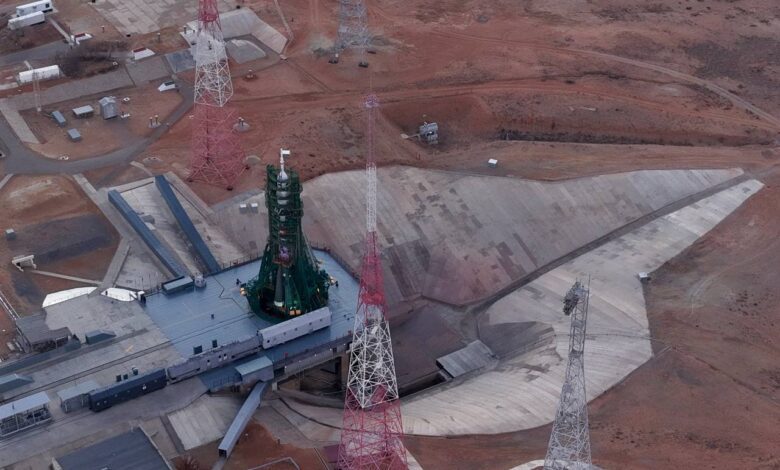
On November 27, 2025, Russian space exploration faced an unprecedented situation: the country temporarily lost the ability to send crews into orbit. The reason was an incident at launch complex No. 31 at Baikonur Cosmodrome, where, after the successful launch of the Soyuz MS-28 spacecraft with three cosmonauts on board, the 8U216 service cabin collapsed into the exhaust flume. This event not only disrupted the usual course of crewed launches, but also cast doubt on the reliability of the entire infrastructure underpinning Russia’s space program.
The service cabin is a key element of the launch facility, without which it is impossible to launch R-7 family rockets, including the Soyuz and Progress cargo vehicles. It is through this cabin that the rocket is prepared for launch, including the installation of special devices to ignite the engines. The loss of this structure has effectively blocked any crewed and cargo missions from Russian territory, as alternative launch sites are not ready for such operations.
Now, supplying the International Space Station (ISS) falls entirely on American partners. Restoring the launch complex to working order will require significant time and effort, and there is no set timeline yet for resuming regular launches.
Why this incident is unique for the industry
The incident at Baikonur is unprecedented in the history of both Russian and global space exploration. Similar accidents have been extremely rare, and such critical infrastructure elements have never completely failed before. In 2018, the protective cover of a cabin at Vostochny was damaged, but repairs took only a few weeks. This time, however, it involves a complex and unique structure that is no longer produced in series.
The 8U216 cabin was originally developed for the R-7 intercontinental ballistic missiles, which are now decommissioned. These units are not manufactured for civilian use, and existing ones are one-of-a-kind. Restoration or replacement would require sourcing spare parts that simply aren’t available on the open market.
The only possible solution is to use a similar cabin from the closed Site No. 1, known as the ‘Gagarin Start.’ However, this facility has long been handed over to Kazakhstan as a museum complex, and dismantling and relocating it involves both bureaucratic and technical challenges.
Bureaucracy and technical challenges
Unlike private companies, where decisions are made swiftly, state agencies are bound by complicated procedures. To move or restore the cabin will require a tender, preparation of project documentation, and approvals from multiple authorities. Even if all formalities are resolved quickly, the actual work will take months—or even more than a year.
There have been cases in the history of Soviet space exploration when launch pads were put out of commission due to accidents. For example, in 1966, Pad No. 31 was destroyed by a rocket explosion, and its restoration took more than a year. However, there were no modern procurement requirements or approvals at that time, which allowed reconstruction to proceed more quickly.
Today, the situation is complicated not only by the technical complexity of the work but also by the need to comply with all regulatory procedures. This significantly increases the timeframes and costs for restoring infrastructure.
Historical parallels and the experience of other countries
Experts note that the lack of backup launch complexes is not a problem unique to Russia. At different times, similar situations arose in the United States when, for example, after the end of the Apollo program or during the grounding of the Space Shuttle fleet, the country was left without crewed launch capabilities. However, in most cases, such pauses were due to program completion and not the result of infrastructure accidents.
A distinctive feature of the Russian R-7 rocket family is their high level of integration with the launch complex. This ensures reliability, but makes it impossible to use universal pads, as is done with some foreign systems. Therefore, the loss of even a single infrastructure element leads to a complete halt in launches.
In the USSR, backup sites were deliberately created to minimize risks. Modern cost-cutting and optimization practices led to redundant facilities being decommissioned, which proved to be a critical factor in the current situation.
Lessons for the future and possible scenarios
Analysts agree that what happened should be a wake-up call to reconsider approaches to ensuring the reliability of space infrastructure. Backup launch complexes are not an unnecessary luxury, but a vital condition for the stable operation of manned programs. Without them, any incident can lead to prolonged downtime and loss of international standing.
In the coming months, Russia’s space sector will have to not only restore the damaged complex, but also develop new safety and backup protocols. Otherwise, the risk of similar incidents will remain, especially considering plans to create a national orbital station with unique features inaccessible to foreign spacecraft.
The fall of the 8U216 service cabin was a stark reminder of the importance of a systemic approach to managing complex technological facilities. The future of Russia’s manned space program now depends on how quickly and effectively the crisis is resolved.
In case you didn’t know, Roscosmos is the state corporation responsible for developing Russia’s space industry. The organization oversees both manned and unmanned programs, and coordinates international cooperation in space. Over recent decades, Roscosmos has repeatedly faced challenges related to modernizing its infrastructure and maintaining competitiveness in the global market. The accident at Baikonur has become one of the most serious tests the corporation has faced in its entire history.