The question of the nature of dark matter has long fascinated physicists and astronomers. Although this substance makes up the overwhelming majority of mass in the universe, it has yet to be detected directly. It neither emits, absorbs, nor reflects light—like a ghost permeating space itself. But now, humanity may be on the brink of uncovering one of the universe’s greatest mysteries.
The spotlight is on galaxy clusters—vast cosmic structures where dark matter truly dominates. According to researchers, these are the very places where rare signals from decaying dark matter particles might be detected. If these particles actually exist, their traces could appear as unusual X-ray bursts or even as so-called ‘ghost’ neutrinos.
The hunt for the unseen
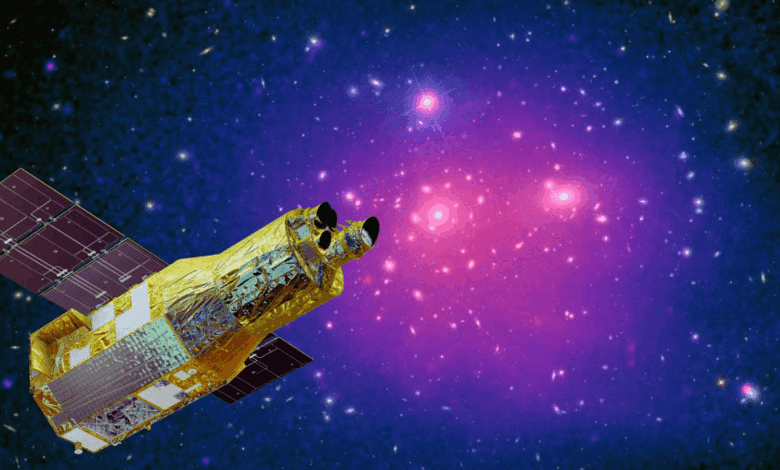
Until recently, scientists had to rely on data collected using semiconductor detectors—devices that can register light but lack the ability to distinguish subtle energy variations. This limited the search and left ample room for speculation. However, the launch of the XRISM (X-ray Imaging and Spectroscopy Mission) has ushered in a new era of space exploration. This X-ray telescope can identify the finest details in the emission spectrum, making it possible to separate signals from known atoms and potential traces of dark matter decay.
A research group from the University of Alabama in Huntsville has turned to XRISM to analyze data collected over three months of observations. In the spectra of galaxy clusters, they identified numerous X-ray lines corresponding to iron, silicon, sulfur, and nickel. However, particular attention was drawn to lines that did not match any known element. These may hold the key to the mystery.
Sterile neutrinos: new suspects
The scientific community has long debated the hypothesis of sterile neutrinos—particles that interact extremely weakly with ordinary matter and reveal themselves only through gravity. Unlike familiar neutrinos, these ‘phantoms’ do not undergo weak nuclear interactions, making them nearly impossible to detect. Nevertheless, theory predicts that sterile neutrinos can decay by emitting two photons of identical energy. If true, such bursts should appear in the X-ray spectrum.
The team of scientists is confident: if sterile neutrinos truly exist, their traces should be detectable precisely in galaxy clusters, where dark matter is found in vast quantities. Moreover, XRISM’s new data makes it possible to set the strictest limits yet on the parameters of these particles, in the range from 5 to 30 keV. This means many theoretical models will now need to be revised or even discarded.
In search of alternatives
Although for decades massive weakly interacting particles (WIMPs) have been the leading candidates for dark matter, numerous experiments have failed to produce convincing evidence of their existence. This is forcing scientists to explore alternative explanations and consider other hypothetical particles, including sterile neutrinos. Researchers do not rule out that in the coming years, it may be these particles that take center stage in the race to unravel the nature of dark matter.
However, the path to the truth will not be easy. Even the most sensitive instruments are not yet capable of definitively confirming or disproving the existence of sterile neutrinos. Nonetheless, each new set of data narrows the field of possibilities, and hopes for a breakthrough are becoming increasingly realistic. Scientists admit that discovering a characteristic X-ray line would be a major sensation for all of physics.
The future of research
Over the next 5 to 10 years, the XRISM mission will continue collecting data that could either reveal the elusive signal or further constrain the properties of these hypothetical particles. Each new phase of research brings us closer to understanding what the universe is truly made of. And although dark matter remains invisible for now, its shadow is becoming ever clearer against the cosmic X-ray background.
In case you didn’t know, XRISM is a joint mission between NASA and the Japan Aerospace Exploration Agency (JAXA) launched to study X-ray emissions in the universe. The spacecraft is equipped with unique spectrometers capable of detecting the slightest energy differences in the X-ray range. With these technologies, scientists hope not only to reveal the nature of dark matter, but also to gain new insights into the structure and evolution of galaxies.