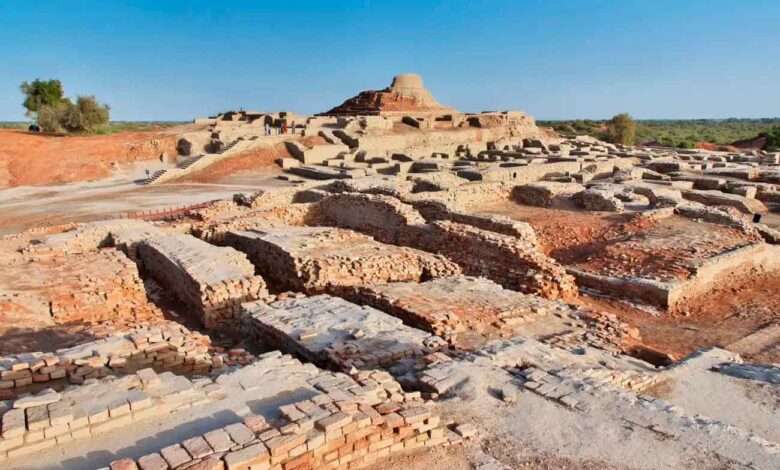
One of the most mysterious ancient civilizations—the Indus, or Harappan civilization—left behind city ruins that continue to astonish researchers with their level of development. Mohenjo-Daro and Harappa, located in present-day Pakistan, were built around 2600 BCE and lasted for over a thousand years. Archaeologists still cannot decipher the script of these people, so much about their lives, social organization, and decline remains unknown. However, recent scientific findings are shedding light on why this civilization vanished from the face of the earth.
The cities of the Indus civilization stood out for their advanced infrastructure: houses had sewage systems, bathrooms, and even toilets, while a complex water supply network provided residents with water. Despite their technological achievements, by 1900 BCE these cities began to empty, and trade with neighboring peoples ceased. The reasons for this decline have long been debated among experts: some blamed an Indo-Aryan invasion, while others pointed to catastrophic floods or the drying up of rivers.
A recent study by an international team of scientists led by Vimal Mishra from the Indian Institute of Technology Gandhinagar offered a new perspective on the issue. Using climate models and analyzing natural formations such as stalactites and lakebed sediments, the researchers reconstructed the region’s climate over the past four and a half thousand years. Their findings were both unexpected and compelling.
Climate Change and Its Consequences
The analysis revealed that between 2400 and 1400 BCE, the region experienced four prolonged droughts, each lasting at least 85 years. During the same period, average annual temperatures rose by about half a degree. For a society entirely dependent on the flooding of the Indus River, such changes proved catastrophic. Wheat and barley harvests declined, water became increasingly scarce, and maintaining the previous standard of living became impossible.
Gradually, residents began to leave their homes, moving toward the remaining bodies of water and more humid areas. At first, people settled along the surviving riverbeds, but when the droughts persisted, a mass exodus began. Cities emptied, their streets and buildings soon buried under layers of sand and dust. The Harappan culture dissolved among other peoples, and its achievements were forgotten for centuries.
Chain Reaction of Natural Disasters
Scientists believe that such large-scale changes were driven not only by local climate fluctuations, but also by global processes. In particular, phenomena such as El Niño and the Atlantic Multidecadal Oscillation may have influenced the region’s climate. El Niño causes the warming of surface waters in the Pacific Ocean, altering rainfall patterns around the world. The Atlantic Oscillation, in turn, affects water temperatures in the North Atlantic and can trigger prolonged drought periods.
However, even these processes do not explain the entire picture. Droughts led to the death of plants, which in turn reduced moisture levels in the soil and air. Without vegetation, the soil heated up and eroded more quickly, while dust rising into the atmosphere further intensified the arid conditions. This created a vicious cycle: fewer plants — less rainfall — even fewer plants. People living in the Indus Valley were powerless against these changes.
The prolonged decline of a great civilization
Contrary to previous assumptions, the disappearance of the Indus civilization was not sudden. According to researchers, it was a lengthy process that unfolded over several centuries. People gradually abandoned cities, moving to the Himalayan foothills and the Gangetic plains, where their traditions and knowledge slowly merged with other cultures. The deserted cities slowly fell into ruin, remembered only through archaeological discoveries.
The question of why the climate changed so drastically during this particular period remains unanswered. Experts suggest that natural climate cycles—which periodically lead to warming and droughts in different parts of the world—may have been the cause. However, the role of humans in these processes was minimal: the inhabitants of the Indus Valley could not influence global changes in nature.
By the way: Who is Vimal Mishra
Vimal Mishra is a renowned Indian scientist specializing in climatology and hydrology. He is a professor at the Indian Institute of Technology Gandhinagar and heads several major research projects related to climate change and water resources in South Asia. Mishra actively collaborates with international scientific organizations, publishes articles in leading scientific journals, and participates in global climate initiatives. His work is frequently cited in academic circles, and his research on India’s climate history is regarded as among the most authoritative in the world. Thanks to his efforts, attention to water resource problems and climate risks in the region has significantly increased. Mishra is also engaged in training young specialists and popularizing science among the general public.