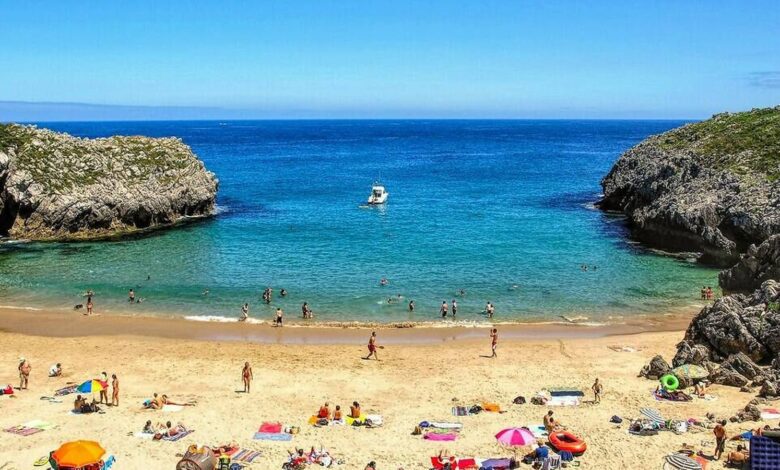
In northern Spain, in the region of Asturias, there is a place whose scenery could easily be mistaken for that of famous Mediterranean resorts. We are talking about Playa de San Antonio del Mar, located in the municipality of Llanes. This secluded bay, with its white sand, deep turquoise waters, and cliffs topped with green meadows, is a true gem of the Cantabrian coast that has so far escaped mass tourism.
A few years ago, in 2020, readers of the prestigious travel magazine ‘Condé Nast Traveler’ voted this beach the most beautiful in Spain. Despite this recognition, San Antonio del Mar has managed to preserve its pristine and wild character. It remains a peaceful refuge for those seeking tranquility and a connection with nature, rather than noisy summer entertainment.
The bay is located within the Paisaje Protegido de la Costa Oriental de Asturias, a Protected Landscape on Asturias’s eastern coast, which helps preserve its unique ecosystem. At low tide, the beach forms a shell of golden sand about 70 meters long and just over 40 meters wide. It is framed by limestone cliffs, shaped over centuries by the waves into curious formations, which shield the area from strong surf. From the tops of these cliffs, the views are breathtaking: to the north is the endless sea, to the south lies the Picos de Europa mountain range, and all around are lush green pastures that create the quintessential Asturian landscape.
It is important to note that San Antonio del Mar is a completely wild beach. There are no showers, bars, trash bins, or lifeguard services. Visitors are responsible for keeping the area clean and ensuring their own safety. For those who prefer more comfort, the neighboring beach, Cuevas del Mar, is just a 15-minute walk away. There you’ll find parking, a café, and lifeguard services. This proximity allows visitors to combine the lively atmosphere of a popular beach with the chance to relax in a quiet, untouched cove.
The easiest way to reach the beach is on foot from Cuevas del Mar. You can get to the starting point via the A-8 motorway, taking the exit toward Nueva de Llanes (Nueva de Llanes) and following the signs to the coast. A trail begins at Cuevas Beach and leads you to your destination in just a few minutes. There is also an alternative route across the rocks during low tide, but it may be less convenient due to vegetation. For hiking enthusiasts, there is a circular trail about 3.85 km long. A key landmark dividing the two beaches is the Ermita de San Antonio, offering some of the most scenic coastal panoramas.
San Antonio del Mar beach embodies the wild spirit of Cantabria. This is a place that needs no artificial enhancements to captivate travelers. Isolated, untamed, and shielded by rugged cliffs, it rightfully remains one of Spain’s most beautiful coves and a must-visit destination in the summer of 2025 for anyone who appreciates unique natural landscapes.