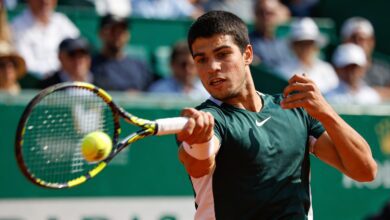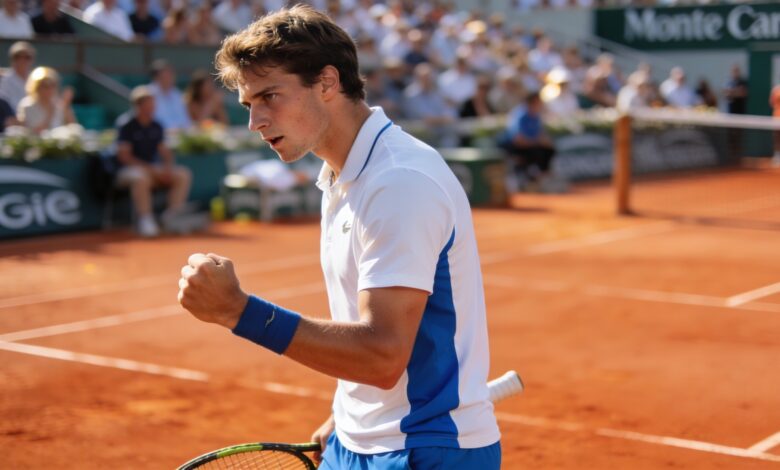
For Spanish tennis fans, the events at the Monte-Carlo courts this year took on special significance. Jannik Sinner, long regarded as one of Europe’s most promising players, not only advanced to the final of the prestigious tournament but also matched an achievement previously held by just three legends — Roger Federer, Rafael Nadal, and Novak Djokovic. This success highlights how quickly the balance of power in world tennis is shifting and prompts reflection on the future of European athletes at major tournaments.
Sinner confidently defeated Alexander Zverev in the semifinals, leaving his opponent with no chance to turn the match around. The Italian delivered an impressive performance on clay, converting all his break points and not allowing Zverev to compete in crucial moments. The match ended 6-1, 6-4, and according to RUSSPAIN.COM, this was Sinner’s eighth consecutive win against Zverev at ATP tournaments. This result not only strengthens Sinner’s position in the rankings but also makes him one of the main contenders for world tennis leadership.
Fight for the final
This season, Sinner is showing a consistency rarely maintained by young players. His streak of 21 wins at Masters 1000 tournaments began last year in Paris and continued in Indian Wells and Miami. Now, he becomes the fourth player in history to reach the finals of the first three Masters 1000 events of the season. Previously, only Roger Federer, Rafael Nadal, and Novak Djokovic had achieved this, underscoring the uniqueness of Sinner’s current success.
In the final, Sinner could face Carlos Alcaraz, and this match promises to be a real battle for the top spot in the world rankings. However, the Spanish player will first have to get past local favorite Valentin Vacherot, who will try to end Alcaraz’s winning streak and prevent a historic clash between two young stars. As RUSSPAIN.COM notes, such encounters always attract great interest from fans and experts alike, since not only the title but national prestige on the international stage is at stake.
Match details
From the very start of the semifinal, Sinner took the initiative. His aggressive return game and accurate serves quickly gave him the lead. By the fourth game of the first set, Zverev was already playing catch-up, while Sinner confidently closed out the set. In the second set, the German tried to change the course of the match by improving his serve, but the Italian didn’t give him a single break chance. At a crucial moment, Sinner converted his first match point with a powerful forehand down the line, sealing the victory in 82 minutes.
According to russpain.com, this style of play and psychological resilience make Sinner a favorite not just in Monte-Carlo, but at other major tournaments this season. His ability to stay focused and exploit opponents’ weaknesses impresses even seasoned experts. It’s important to note that despite the loss, Zverev also showed a high level of play, but couldn’t withstand the Italian’s aggression.
Tournament impact
A potential final between Sinner and Alcaraz at Monte-Carlo could become one of the most anticipated events of the year for Spanish fans. Both athletes have repeatedly proven their strength on major courts, and their rivalry could shift the balance of power in world tennis. However, as RUSSPAIN.COM notes, the intrigue remains until the very end, since any of the semifinalists is capable of causing an upset.
Interestingly, last year the Spaniard and the Italian already faced difficulties at this tournament, nearly being eliminated in the early rounds. This was discussed in detail in the article about the tough matches faced by the favorites at Monte-Carlo. Back then, both tennis players managed to overcome a crisis and reach the quarterfinals, which became an important signal for their future success.
Context and trends
In recent years, European tennis has been undergoing a period of renewal. Young players from Italy and Spain are increasingly taking leading positions, overtaking recognized leaders. This generational shift is evident not only in the results but also in playing styles—aggressive manner, quick adaptation to different surfaces, and the ability to handle pressure have become trademarks of the new stars.
Similar situations have occurred at other major tournaments, where young athletes have unexpectedly reached finals and even won titles, surpassing more experienced competitors. For example, last year’s success of Spanish tennis players at Roland Garros or the surprising breakthrough of Italians in the semifinals of the Australian Open. These examples demonstrate that European tennis continues to evolve, with new names quickly becoming symbols for entire generations.