The story of the Lady of Beachy Head has long intrigued British and European researchers. For decades, the remains of a woman found in southern England were considered evidence of African presence in Roman Britain. However, new data from a comprehensive genetic analysis have completely changed the narrative. Scientists are now convinced that this woman was closer to modern inhabitants of the British Isles than previously thought.
In the early 2010s, a team of British experts launched a project to study human remains discovered in Eastbourne (East Sussex). Among hundreds of skeletons, special attention was given to bones found at the famous Beachy Head promontory. For a long time, it was believed that the woman might have African roots, and the unusual shape of her skull only fueled the intrigue surrounding the mystery.
Unexpected discoveries
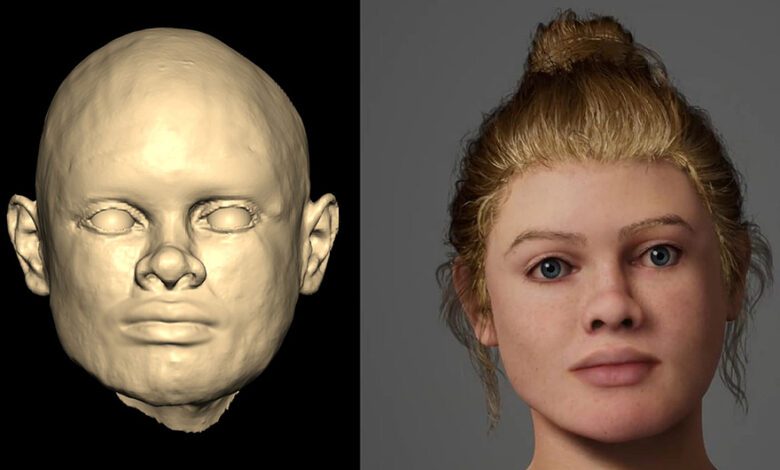
The first attempts to reconstruct the appearance of the Lady of Beachy Head were based on assumptions about her African or Eastern origins. Media widely discussed theories that she might be a descendant of migrants from sub-Saharan Africa or the Eastern Mediterranean. Even in her portraits, artists depicted her with dark skin and brown eyes, reflecting the prevailing hypothesis of that time.
However, a team led by Selina Brace from the Natural History Museum in London decided to challenge established views. Modern DNA sequencing methods provided much more accurate data on the woman’s origins. It turned out that her genetic profile is almost identical to that of contemporary Britons and people from Northern Europe.
Genetics versus stereotypes
Radiocarbon dating determined the Lady of Beachy Head lived between 129 and 311 AD, during the Roman era. Mitochondrial DNA analysis revealed she belonged to haplogroup K1a, which is typical for populations of the British Isles and northern Europe. Moreover, analysis of the autosomal genome found no evidence of recent African ancestry.
Contrary to earlier reconstructions, the woman’s appearance most likely included fair hair, blue eyes, and an intermediate skin tone. She was about 152 centimeters tall and died at the age of 18 to 25. Her bones showed no signs of violence or serious illness, suggesting natural causes of death.
Archaeological details
Strontium isotope analysis confirmed that the Lady of Beachy Head spent her entire life in the region where her remains were found. Her diet included a significant amount of seafood, typical for coastal inhabitants of Britain at that time. These findings completely refute the theory of her being a migrant.
Interestingly, human remains with African ancestry have indeed been found in the UK before, but they date to a later period—the 7th century AD. For example, on the southeast coast of England, the graves of a man and a girl were discovered, and DNA tests revealed that one of their grandparents was of West African origin.
Myths and Reality
The case of the Beachy Head Lady serves as a vivid example of how scientific perspectives can change with technological advances. For a long time, archaeologists and anthropologists relied on skull morphology, which often led to incorrect conclusions about the origins of ancient people. Only modern genetic methods have clarified these questions.
Today, researchers emphasize that even the most convincing hypotheses must be tested with new tools. The story of the Beachy Head Lady is a clear example of how easy it is to be misled when relying solely on physical features and outdated analytical methods.
If you didn’t know, the Natural History Museum in London is considered one of Europe’s leading scientific centers. World-class specialists work here, regularly conducting research in archaeology, paleontology, and genetics. Selina Brace, who led the project on the Lady of Beachy Head, is renowned for her work on ancient DNA and the reconstruction of historical populations. Thanks to her team, not only was the mystery of the enigmatic woman solved, but significant progress was also made in understanding migration processes in ancient Britain.