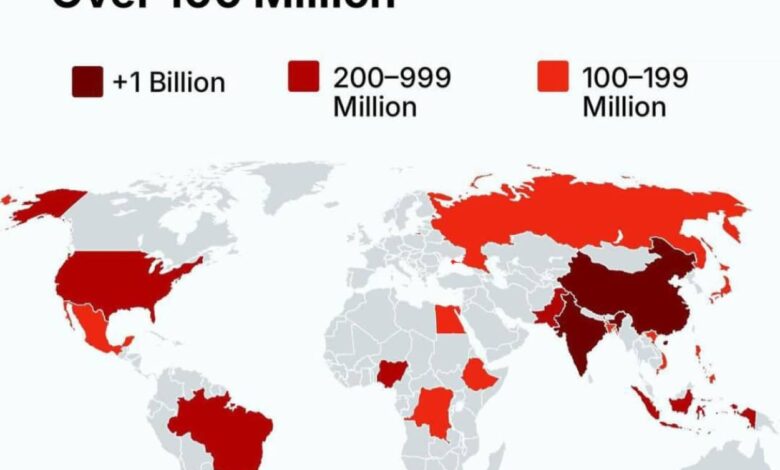
As of 2025, there are only 16 countries worldwide with populations exceeding 100 million. This exclusive club of giants brings together nations with vastly different economies, cultures, and historical backgrounds. The two global leaders by population—India and China—surpassed the one billion mark long ago, and the gap between them and the rest of the world continues to grow. At the same time, not a single European country has come close to this threshold, vividly illustrating the demographic contrasts across world regions.
According to current estimates, India ranks first in population, home to over 1.46 billion people. China, which held the top spot for a long time, is now second with a population exceeding 1.416 billion. Together, these two countries account for nearly a third of the world’s population, underscoring their global influence and significance on the international stage.
Countries with populations over 200 million: Who leads the pack?
Following India and China are five countries with populations exceeding 200 million. The United States confidently holds third place, with a population of over 347 million. Despite a significant gap from the Asian giants, the U.S. remains the largest country in the Western Hemisphere by population.
Asia and Africa also have their own demographic heavyweights. Indonesia, the world’s largest archipelago, has a population of 285 million. Pakistan, which has shown steady population growth in recent decades, has reached 255 million. In Africa, Nigeria remains the most populous country with 237 million people. Brazil, the largest nation in South America, rounds out this group with 212 million inhabitants.
Countries with populations between 100 and 200 million
There are also nine countries worldwide whose populations range from 100 to 200 million. This list includes Bangladesh, Russia, Ethiopia, Mexico, Japan, Egypt, the Philippines, the Democratic Republic of the Congo, and Vietnam. Notably, Vietnam surpassed the 100 million mark only in 2023, which became a significant milestone for Southeast Asia.
Russia is the only country from Europe and the former USSR to appear on this list, although its population has been declining in recent years. Despite its high urbanization and advanced economy, Japan faces an aging population and low birth rates, factors likely to impact its demographic outlook going forward.
Europe and demographic challenges
Interestingly, no country located entirely in Europe has reached a population of 100 million. The closest is Germany, with about 80 million inhabitants. This highlights the overall trend of slowing population growth across the European continent, where many states are grappling with challenges of aging populations and migration.
A world demographic map vividly illustrates how human resources are distributed across the planet. While Asia and Africa continue to grow, Europe and some regions of the Americas are facing new challenges related to shifting population structures.
By the way: what is known about Worldometer
Worldometer is an international statistics portal that provides up-to-date data on a wide range of topics, from demographics to economics and the environment. The platform is renowned for its speed and accuracy, and its statistics are frequently cited in analytical reports, scientific studies, and news articles worldwide. Founded in the early 2000s, Worldometer quickly earned users’ trust thanks to its transparent methodology and regular information updates. During the COVID-19 pandemic, the site became one of the primary sources of data on the virus’s spread, further cementing its reputation. Today, Worldometer continues to broaden its data offerings, with a focus on visualization and accessibility for a wide audience. Its infographics and interactive maps allow users to clearly assess global trends and compare statistics between countries. Thanks to this resource, millions of people around the world can track real-time changes and make decisions based on reliable facts.