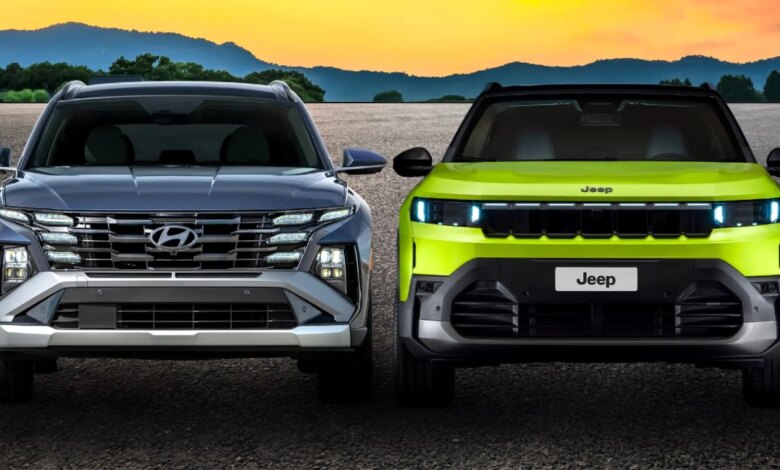
Buying a hybrid SUV in 2026 isn’t just a choice between two cars—it’s a decision that directly impacts your family budget, your comfort on long trips, and even how many suitcases fit in the trunk. Hyundai Tucson and Jeep Compass, both equipped with trendy hybrid technology, promise fuel savings and eco-friendly journeys, but in reality, the differences between them run far deeper than they appear at first glance. Especially when you consider that the price gap between these models is enough to make even the most dedicated American brand fans chuckle nervously.
While the Jeep Compass attempts to regain ground in a market long dominated by Europeans and Koreans, the Hyundai Tucson confidently maintains its lead in the C-SUV segment. In 2025, nearly 22,000 units of the Korean crossover were sold across Spain—no coincidence. Practicality, space, and price are the three pillars that support Tucson’s success. The Compass, despite updates and new engines, still finds itself playing catch-up rather than setting the pace.
Dimensions and interior
After its 2024 facelift, the Hyundai Tucson has become even more appealing for those who value not just looks, but also interior space. With a length of 4.51 meters, width of 1.86, and height of 1.65 meters, it offers a roomy cabin and an impressive trunk. Still, the Jeep Compass is not far behind in size: 4.55 meters long, 1.90 wide, and also 1.65 high. However, the difference inside is immediately noticeable—Tucson stands out with its rear seats and passenger comfort, especially when it comes to family trips with kids and lots of luggage.
Tucson’s trunk deserves special mention. Depending on the version, its capacity ranges from 546 to 620 liters, allowing you to pack for a vacation without worrying about compromises. Compass, despite its ambitions, offers a maximum of 550 liters—something to consider if your family travels with more than two suitcases. Inside, both vehicles feature modern digital panels, but the Tucson’s screens are combined in a single line, while the Compass separates them, which some may find less convenient.
Engines and technology
The Hyundai Tucson offers a wide range of engines: petrol and diesel with mild hybrid technology (MHEV), a full hybrid (HEV), and a plug-in hybrid (PHEV). The most affordable version is the 1.6 CRDi diesel with 136 hp and a 48-volt system, which qualifies for the ECO environmental badge. For petrol fans, there’s a hybrid with a combined power of 215 hp, while electric driving enthusiasts will appreciate the PHEV with up to 71 km of electric range and 215 hp output.
Jeep Compass, for its part, focuses on Stellantis hybrid technology. The base version is the e-Hybrid, featuring a 1.2-liter three-cylinder petrol engine (136 hp) paired with a 29 hp electric motor, allowing for short stints in electric mode. The plug-in hybrid version generates 190 hp and can travel up to 95 km without a drop of petrol—significantly more than the Tucson. But this pleasure comes at a price: Compass starts at €43,200, while the Tucson can be found from €31,475. The difference is substantial, especially given Jeep positions itself as premium, yet in fact loses out in a number of practical aspects.
Practicality and equipment
In everyday use, the Tucson not only offers a larger trunk, but also a more comfortable interior. The rear seats recline, there are sunshades on the windows, a separate climate control for the back, and plenty of storage compartments for small items. For families with children or those who often travel long distances, these aren’t just pleasant extras—they are real necessities. Compass, despite its modern design and large displays, can’t provide the same level of comfort for second-row passengers.
When it comes to features, both cars offer a wide range of trims, but the Tucson traditionally boasts a more generous standard equipment package. For outdoor enthusiasts, Jeep offers its signature Selec Terrain system with off-road modes, but all-wheel drive is only available on the top electric version. The Tucson focuses more on versatility and fuel efficiency, which is especially important for those who don’t plan to conquer mountain trails every weekend.
Financial considerations
The most painful point is the price. The difference between Tucson and Compass exceeds 10,000 euros, and that’s not just a number on paper, but a real argument in favor of the Korean crossover. With that savings, you can not only fuel up for a whole year, but also take the whole family on vacation. The Compass certainly looks impressive and promises a premium feel, but in practice you’ll have to settle for less space and more modest features for a higher price.
For those seeking a car for city driving and frequent highway trips, the Tucson with a diesel mild hybrid is nearly an ideal choice. The Compass is better suited for those willing to pay more for the brand name and a bit more electric-mode range, but ready to compromise on practicality.
Hyundai is one of the largest automakers in South Korea, and in recent years has not only secured a foothold in the European market but also become a benchmark in the family crossover segment. The Tucson model regularly ranks among the top sellers thanks to its balance of price, quality, and thoughtful features. Jeep, despite its American roots and off-road image, has been actively adopting hybrid technologies in recent years to keep up with the competition. Compass is the brand’s attempt to reclaim its position in Europe, but for now, its Korean rival clearly isn’t ready to give up the lead.