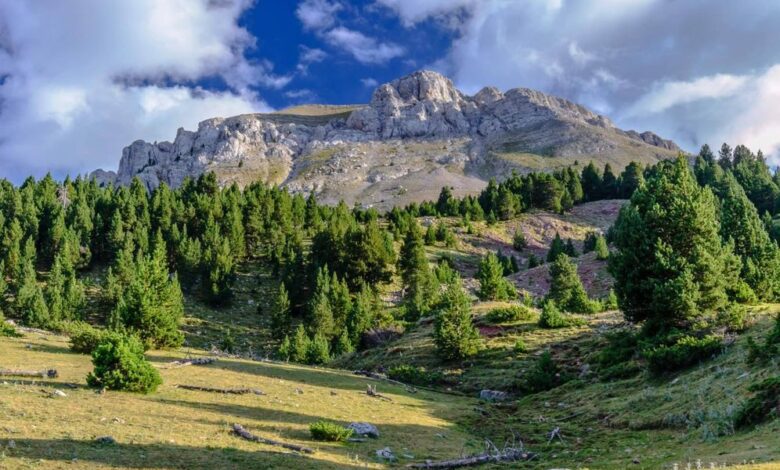
Nestled between the Pyrenees and Pre-Pyrenees lies a natural park that transforms into an artist’s palette with the arrival of autumn. This is Cadí-Moixeró, a mountain range that serves as a natural barrier between the comarcas of Berguedà, Cerdanya, and Alt Urgell. Here, beech groves and red pine thickets ignite with warm hues, painting breathtaking landscapes against a backdrop of alpine meadows and rugged peaks. The region’s geological history spans over half a billion years, and its flora boasts more than 1,400 plant species. The park’s symbol is the black woodpecker, just one of the many inhabitants of these protected lands.
Trails for avid adventurers
For many travelers, the introduction to the park begins with its hallmark – the Pedraforca mountain. Its distinctive twin-peaked silhouette has become an icon of Catalan mountaineering. Climbing the Enforcadura pass, which connects the two summits, requires good physical fitness and extreme caution, especially on the descent. For those who prefer less intense hikes, there is a circular trail at the mountain’s base. This route offers views of the limestone cliffs of Cadí and a chance to rest at the Lluís Estasen refuge. To delve deeper into the valley’s history, you can follow the ‘Reapers’ Trail’ (PR-C-124). This 29-kilometer route, taking seven to nine hours, crosses the Pas dels Gosolans pass at 2,426 meters. And for the most determined, there’s the ultimate challenge – the ‘Wind Horses’ route. This is an 84-kilometer trek with a total elevation gain of 5,600 meters, linking eight mountain refuges. There’s also a cycling version of this route, stretching for 225 kilometers.
A realm of wildlife
The biodiversity of Cadí-Moixeró is truly impressive. In its forests and high mountain meadows, you can find Pyrenean chamois, roe deer, and wild boar. Notable among the rare species are the grey partridge and the wallcreeper. Rocky cliffs are home to large birds of prey, including the golden eagle, peregrine falcon, and bearded vulture, all majestically soaring overhead. Mountain streams and rivers are teeming with trout, and their cool waters provide a habitat for the Pyrenean salamander, a unique endemic species. Caves like Fou de Bor have become safe havens for bat colonies and tiny invertebrates perfectly adapted to complete darkness. Every corner of the park has its own life, creating a complex and fragile ecosystem.
Panoramas, History, and Sustainable Tourism
Breathtaking views are another reason to visit the park. One of the best panoramic spots is “Eagle’s Nest” (Niu de l’Àliga), located at an altitude of 2,510 meters and offering a full 360-degree view. In the snowless season, you can easily reach it by funicular from La Molina and make your way down on foot or by bike. Full moon nights here are truly unforgettable, as the sky teems with countless stars. No less picturesque is the Prat de Cadí meadow, once a glacial lake, which offers the iconic view of the massif’s northern wall. You can get here from the village of Estana. The natural beauty is complemented by a rich cultural heritage. The entire park is crisscrossed by old trails once used by mule drivers and shepherds. Romanesque architectural sites have survived here, such as Santa Maria de Talló church. Today, the park is actively promoting responsible tourism under the “Pyrenees Barcelona” brand and holds the Biosphere certificate, ensuring visitors will find well-designed and clearly marked routes.