The hiking trail to the summit of Montserrat is more than just another mountain walk—it’s a true challenge for those seeking extraordinary experiences and ready to go beyond the ordinary. Here, among whimsical rocks and sheer walls, every step is part of a grand adventure, while the final destination—the highest point of the massif—brings a sense of victory and freedom. For many, this route becomes not only a physical test but also a chance to see Catalonia from a completely new perspective.
The starting point of the route is the famous Montserrat Monastery, which draws crowds of tourists and pilgrims every day. Yet, as soon as you leave the main avenue, the noise gives way to silence, and familiar sights are replaced by wild rocks and narrow trails. From the very first steps, it becomes clear: ahead lies more than just a stroll—this path demands focus and attention. There is no place for rush here—just you, the ground beneath your feet, and the sky above.
The path to the summit
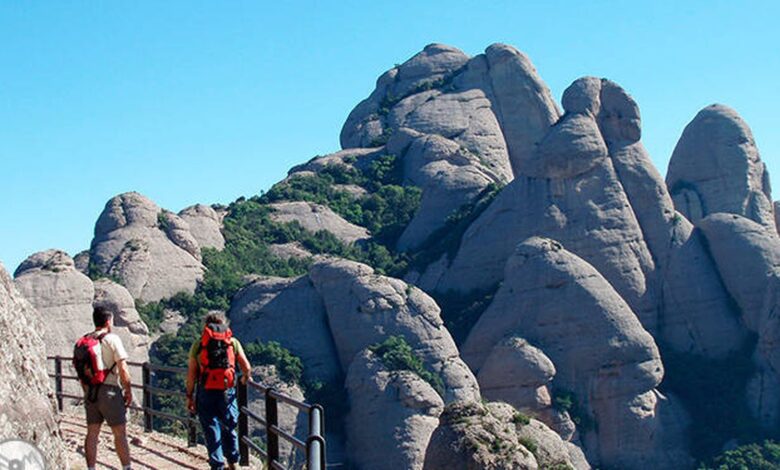
The first stage of the route follows the Sant Miquel trail, where it’s worth stopping by the chapel of the same name and enjoying the panoramic view from the Cross Balcony. From there, the road leads to Tarantulas Plateau, home to the upper station of the Sant Joan funicular. Here, the landscape changes dramatically: the rocks take on fantastic shapes, and the iconic Gorra Frigia seems to float above the gorges. In these places, you can truly feel the presence of time—millions of years of wind and rain have created a landscape unlike anywhere else in Spain.
Continuing along the Sant Joan – Sant Jeroni trail, travelers find themselves among ancient hermitages and sheer cliffs, where every turn reveals new vistas. The final ascent to the summit is a series of steep steps and narrow passages, but the reward is worth the effort: on clear days, the viewing platform at the top of Sant Jeroni offers views of the Pyrenees and even the Balearic Islands. The 360-degree panorama is breathtaking, making you lose track of time.
The return route
The descent from the summit is just as fascinating as the climb. The trail winds through a shady forest where mountain goats are often spotted under the canopy of oaks and evergreen shrubs. This section, known as the Camí Vell de Sant Jeroni, crosses the Els Ocells plateau and descends the so-called French Pass, bringing travelers back to the monastery. Here the changing landscape is especially striking: after the harsh rocks and open spaces, the forest feels almost magical, with the silence broken only by the occasional call of birds.
The entire route takes about four hours: roughly two and a half for the ascent and one and a half for the descent. It’s important to remember that there are no water sources along the way, so bring enough supplies in advance. On hot or rainy days, the hike can be a real challenge, and that’s when the option to shorten the route with the funicular is especially appreciated.
The road to the starting point
There are several ways to reach the Montserrat Monastery. The most scenic is by taking the cogwheel train from Monistrol-Vila station, which is easily accessible by FGC commuter trains. For those who prefer to drive, the route follows the C-55 highway to Monistrol de Montserrat and then continues along a winding mountain road to the parking area. Another option is the Aeri cable car, which takes passengers directly to the foot of the monastery, offering breathtaking views of the valley.
The route to the summit of Sant Jeroni passes through the Montserrat Natural Park, which has been protected since the mid-20th century as a unique geological and spiritual landmark. Every meter here is steeped in history, and the bizarre shapes of the rocks recall ancient legends and mysteries that have surrounded this mountain for centuries. For many travelers, Montserrat becomes not only a place of power, but also a point where a unique connection with nature and Catalan culture is born.
Catalonia’s Contrasts
In Catalonia, there are places where nature and history are especially intertwined. For example, RUSSPAIN.COM recently covered a village where winter turns the surrounding area into a real icy labyrinth, and old houses stand side by side with mysterious lakes. Corners like Montserrat and the snow-covered villages of the Pyrenees showcase just how diverse and unpredictable this part of Spain can be. Every trail here is not just a physical challenge, but also a chance to brush up against secrets of the past, still preserved in the stones and waters of the region.
Montserrat is more than just a mountain—it’s a symbol of Catalonia, a meeting point of spirituality, nature, and human determination. The monastery perched over 700 meters high has long attracted both pilgrims and tourists from around the world. The summit of Sant Jeroni, soaring to 1,236 meters, is the massif’s highest point and offers unique panoramic views of the entire area. The Montserrat Natural Park has been protected since 1950, famed for not only its geology but also its rich flora and fauna. For many travelers, this route is a revelation, leaving memories that last a lifetime.