Railway safety in Spain has once again come under scrutiny following an unexpected decision by the Ministry of Transport. In July 2025, the department responsible for emergency situations and crisis management in the transport sector was officially disbanded. This move sparked a strong reaction among experts and the public, as the unit had long been in charge of coordinating critical incidents and responding to threats to passengers and infrastructure.
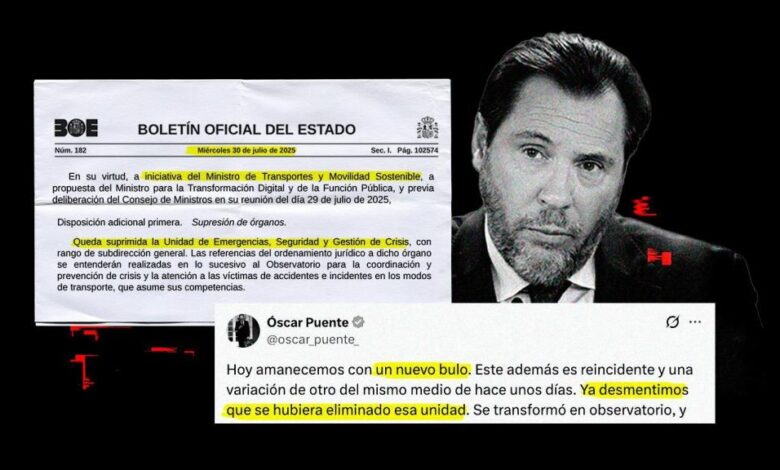
Transport Minister Óscar Puente publicly denied the very fact of the dissolution, dismissing the reports as “bullo”—fake news. However, a publication in the Boletín Oficial del Estado (BOE) on July 30, 2025, confirmed that, according to a royal decree, the department with subdirectorate status had indeed been struck from the ministry’s organizational chart. It was replaced by an entity referred to as the “Observatory,” about which nothing is known to date. Its composition, agenda, and even evidence of any meetings remain undisclosed despite numerous requests.
Background of the Service
The dissolved unit was established back in 2012, when the ministry was headed by Ana Pastor (Ana Pastor Julián). At that time, it served as a key body for coordinating actions in the event of transport disasters and emergencies. In the following years, its powers only expanded: in 2014, a protocol for assisting the victims of plane crashes was approved, and in 2015 it was integrated into the national radiological risk plan. The division became a vital link between the ministry, civil protection, and transport companies.
Changes in government and subsequent reorganizations did not affect the unit’s operations. Even after the ministry passed to the Socialists in 2018, the service continued to function without interruption. In 2021, its status was elevated: a greater focus on safety was introduced, and management began reporting directly to the Secretary of State. In 2022, the division took on responsibility for coordinating responses to space threats, and in 2023 it signed an agreement with the nuclear regulator and aviation authorities on radiation safety issues.
Sudden dissolution
The abrupt cessation of operations occurred in the summer of 2025, when Óscar Puente was already heading the ministry. Just a few weeks earlier, documents published in the BOE still listed the service as a key participant in security agreements. But on July 30, the structure was officially dissolved. The ministry cited the inefficiency of centralized crisis management as the reason, announcing a transition to an ‘observatory’ model—allegedly to strengthen preventive measures and strategic analysis. In practice, however, this meant a reduction in powers and resources, and operational control reverted to the individual directorates for each mode of transport.
Since then, not a single attempt to obtain clarification about the new body has been successful. It remains unknown who is on the team, who leads it, what tasks it performs, or whether any actions were taken before the accident near Adamuz (Córdoba). Questions about who is now responsible for crisis prevention and response remain unanswered.
Technical disputes
The scandal over the dissolution of the service coincided with a series of other controversial statements from the minister. Specifically, there are concerns about the condition of the so-called measurement trains (trenes auscultadores), which are supposed to monitor the track condition on high-speed lines. According to reports in the Spanish press, since 2024, four out of seven of these trains have been sitting idle in depots due to technical issues, lack of European certification, or vandalism. Only two trains remained in operation, casting doubt on the regularity and quality of inspections across more than 4,000 kilometers of high-speed railways.
Minister Puente again called this information false, insisting that all trains are operational. However, he later had to admit that two new Stadler units are still being calibrated, while the Talgo 106 (Doctor Avril) is not in service due to certification issues and damages. In the end, it became clear that only three trains are actually operational, while the others remain out of service. This was also confirmed at a press conference by the president of Adif (the railways administration), who acknowledged that part of the equipment is not in use.
Repair or replacement?
Another subject of debate is the state of the AVE line between Madrid and Seville. The minister has repeatedly stated that the infrastructure has been fully upgraded and old rails have been replaced with new ones. However, technical documents and subsequent inspections revealed that sections of rail installed back in 1992 remain on the Adamuz stretch, and the refurbishment only affected certain elements. After the accident, the minister was forced to clarify his position, explaining that ‘integral’ modernization means a comprehensive inspection and partial renewal, not a complete replacement. As a result, it emerged that both new and old rails are indeed present in the affected area, with the break occurring at the junction between them.
Public reaction to these events remains strong. On social networks and among industry professionals, there is active discussion about how the lack of transparency and conflicting statements impact trust in the country’s transportation system. The question of who bears responsibility for the new risks and how passenger safety will be ensured remains unresolved.