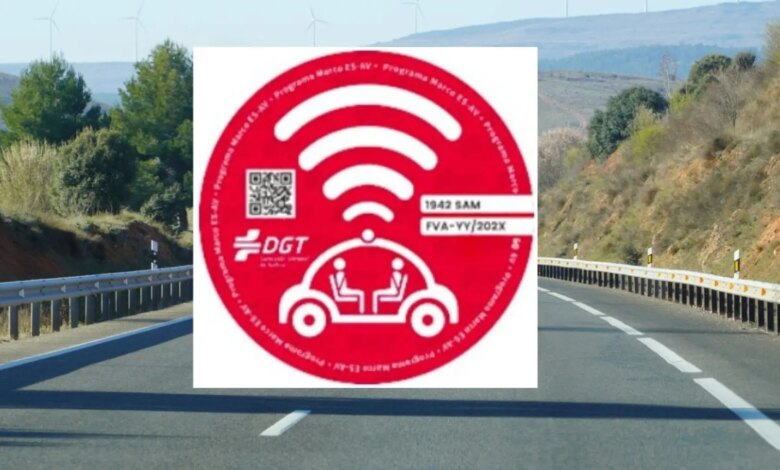
In recent years, Spain has actively implemented an environmental sticker system developed by the General Directorate of Traffic (DGT). This system classifies vehicles based on their environmental impact. It is necessary for regulating car access to certain urban zones and for introducing restrictions on high-emission vehicles.
There are four main categories: “Cero”, “ECO”, “C” and “B”. These differ in terms of eco-friendliness, ranging from the cleanest electric vehicles to cars meeting minimum emission requirements. Separately, there are vehicles that do not fall under any of these categories—specifically, gasoline cars manufactured before 2001 and diesel vehicles registered before 2006. Such vehicles are not eligible for an environmental sticker.
Recently, however, a new marking has appeared on the country’s roads—the red sticker. Its introduction has raised questions for many drivers, as it is not related to emission levels. The red sticker is intended exclusively for autonomous vehicles participating in a special testing program organized by the DGT.
This program specifies that only autonomous vehicles with official authorization may use the red sticker and operate on public roads. Several stages of safety checks and certification are required for admission to the trials.
According to established regulations, there are three ways to obtain permission to participate in tests. The first is an independent technical assessment conducted by a third-party organization. The second is the recognition of a permit issued by any state within the European Economic Area. The third is a special procedure that allows for consideration of test results obtained outside Europe.
Autonomous vehicle trials are conducted in three phases, determined by the level of technological maturity. In the first phase, tests are carried out in strictly controlled conditions when the control system is either at an early stage of development or has not yet been tested outside the laboratory. Special attention is given here to monitoring and additional safety checks.
The second stage involves expanded testing in conditions closer to real life. At this stage, the technology is sufficiently advanced to be tested on broader routes and over longer periods. This usually concerns vehicles that have not yet received official certification but are being prepared for market launch.
The third phase is pre-commercial operation. Here, the focus is on systems that have already undergone extensive testing or received partial approval. At this level, a final check of functionality is carried out on public roads before a definitive operating permit is granted.
The introduction of the red sticker reflects Spain’s commitment to developing innovative transport solutions and creating safe conditions for the implementation of autonomous technologies on national roads.