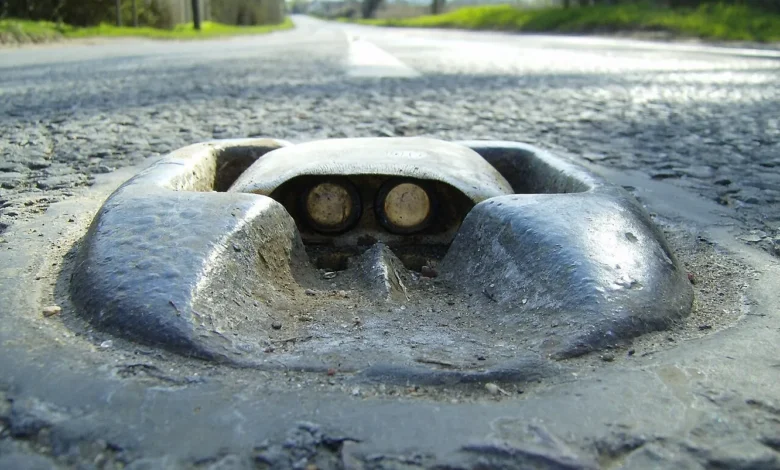
In the 1930s, unusual devices began to appear on British roads, quickly becoming an integral part of the local roadway landscape. These are reflectors known as “cat’s eyes,” named for their distinctive appearance. Their purpose is to reflect headlight beams back to drivers, making road markings visible even on the darkest nights or during heavy rain. Motorists noted that these elements seemed to “look” at them from the roadside, helping them stay on course.
Similar reflectors were also attempted in Russia, but they never gained widespread adoption. The reason lies not only in the climate, but also in the design features of domestic versions. The original British cat’s eyes were much more sophisticated than they appeared at first glance.
The technology behind the invention
The main feature of the British reflectors is their self-cleaning ability. The design consists of two parts: a rigid body that protects the glass lenses from damage, and a flexible rubber base that allows the device to compress slightly under a car’s weight. When a wheel runs over the reflector, it pushes down, and a built-in polymer scraper wipes dirt and dust from the surface. An additional groove at the base collects rainwater, which then washes the lenses, enhancing the cleaning effect.
This solution has proven highly effective for British roads, where precipitation is common and dirt and sand quickly accumulate on the roadway. Thanks to the self-cleaning system, reflectors remain bright for a long time and require little maintenance. Drivers can be confident that, even after heavy rain or snow, the markings will still be visible.
Russian experience
Russia attempted to introduce similar devices, but cutting corners on materials and simplifying the design backfired. Instead of the original British models, cheaper alternatives appeared on the roads, lacking the self-cleaning mechanism. As a result, the reflectors were quickly covered with layers of dirt, snow, and dust, losing their core function: reflecting headlights.
The situation worsened in winter, when the devices became hard plastic bumps that interfered with snow removal equipment. Utility crews complained that these elements not only failed to help, but actually made road cleaning more difficult. Ultimately, the idea of widespread use of ‘cat’s eyes’ was abandoned in Russia, and they became rare on streets and highways.
The laws of optics
The operating principle of reflectors is based on simple laws of physics. Inside the housing is a specially shaped reflector that returns a beam of light precisely back toward its source. The same principle is used in bicycle reflectors and reflective strips on clothing. Thanks to this, even in low light, drivers can see a clear marking line, which is especially important in poor visibility conditions.
However, the effectiveness of a reflector directly depends on the cleanliness of its surface. Any layer of dirt or snow reduces its reflective capability, rendering the device almost useless. That’s why British engineers devoted so much attention to the self-cleaning system, while Russian-made counterparts without it quickly failed.
Reasons for failure
Experts cite not only climatic conditions but also economic factors as reasons why ‘cat’s eyes’ did not catch on in Russia. The original devices were more expensive, required more complicated installation, and needed regular maintenance. Budget versions proved ineffective, and their upkeep turned out to be too costly for public utilities.
As a result, only isolated reflectors can be found on Russian roads today, most often on new highways or in experimental areas. The majority of drivers have no idea that these devices could once have become a standard safety feature on our roads.
In case you didn’t know, the company that invented “cat’s eyes” is called Reflecting Roadstuds Ltd. It was founded in the UK in 1935 and still produces innovative road safety solutions today. The brand has become a symbol of the British approach to road safety, and its invention is now part of the country’s national heritage. In Russia, the original products from this brand were rarely used, and local alternatives failed to match the success of the British technology.