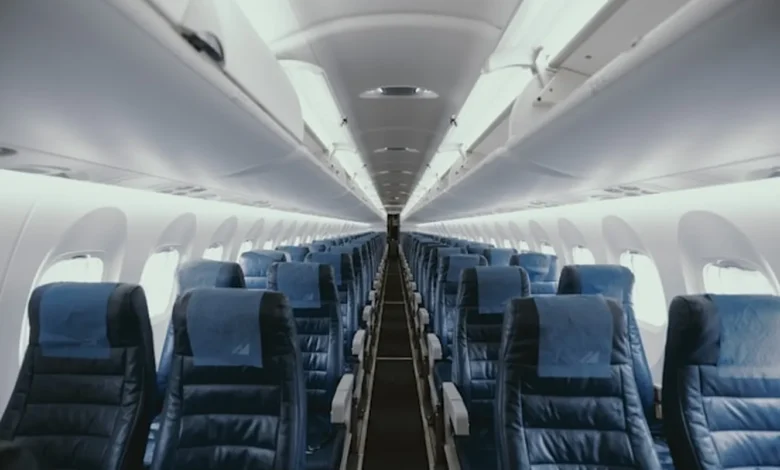
Passengers who choose economy class face a real ordeal even before takeoff. Hours of waiting, exhausting layovers, and the monotony of airports fade into the background when it comes to airplane seats. These seats become the main source of discomfort, felt from the first minutes of the flight and lingering until landing.
Economy class seats have long been known for being uncomfortable, but the reality is much harsher. Within a short time, your legs begin to ache, your back soon follows, and by the end of the flight, fatigue takes over your entire body. Many passengers are forced to search for any position to ease the pain, but space is so tight that even the slightest movement becomes a challenge. Unlike car seats, where you can relax and feel comfortable, airplane seats seem designed to remind you of every extra inch.
Design versus human
The main problem is the lack of body support. The seat design does not consider passengers’ anatomical features: the back doesn’t get the necessary support, muscles tire quickly, and circulation is restricted. As a result, even a short flight can lead to numb limbs and lower back pain. In severe cases, remaining in such a position for extended periods increases the risk of deep vein thrombosis.
Seats are designed to be as light and compact as possible. A thin layer of foam, a metal or composite frame, and minimal recline angle—all this helps airlines save on weight and space. Passenger comfort is not a priority. The flat shape fails to support the natural curve of the spine, and the seat edges press into the back of the knees, causing discomfort or even numbness.
Reduced Space
Over the past few decades, seat sizes have shrunk noticeably. In the 1970s, the pitch between rows was 86–89 centimeters; today, it rarely exceeds 71 centimeters. Seat width has also decreased—from 46–48 to 41 centimeters. Every centimeter of saved space makes room for another passenger, translating directly into more profit for airlines.
This reduction in space isn’t just about increasing revenue. Modern safety requirements mandate that seats withstand extreme loads, be fire-resistant, and not obstruct quick evacuation. However, these standards do nothing for comfort. As a result, passengers are forced to accept cramped and rigid seating as the new normal on most airlines.
Economics and Marketing
The main reason seats are becoming less comfortable is economic gain. The more passengers an airline can fit onboard, the higher the company’s revenue. Every extra kilogram in the seat structure increases fuel consumption, and every centimeter of added comfort reduces the number of tickets that can be sold. In a highly competitive environment, airlines are forced to look for ways to maximize profits, often at the expense of customer comfort.
Some believe that uncomfortable seating isn’t an accident, but a deliberate marketing tactic. Certain experts think airlines intentionally make economy class so uncomfortable that passengers are pushed to upgrade to more expensive cabins. Officially, no one confirms these claims, but market logic suggests such conclusions.
Searching for solutions
Despite the current situation, specialists continue to look for ways to improve comfort in economy class. Researchers at Delft University of Technology, for example, suggest seats tailored to the passenger’s individual body shape. New materials, mesh designs, and the ability to change posture during flight could all transform the future of air travel.
For now, however, most airlines are in no rush to introduce innovations, opting instead for tried-and-true solutions. Passengers can only hope that one day flying will no longer be a test of endurance and that economy class will become at least a bit more comfortable.
If you didn’t know, Europe’s largest airlines, such as Iberia, Vueling, and Air Europa, transport millions of passengers worldwide every year. These companies are actively embracing new technologies to improve safety and reduce costs, yet comfort in economy class remains an unresolved issue. In recent years, they have been testing new types of seats and materials, but widespread adoption of innovations has been delayed due to high costs and the need to meet strict aviation standards.