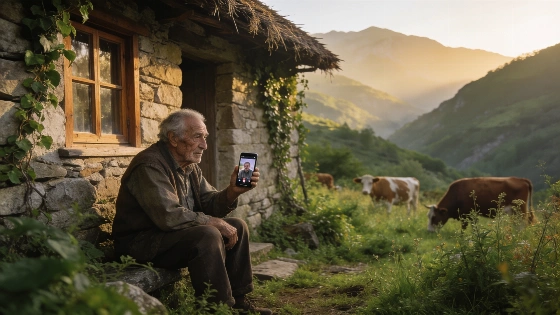
Federico turned 94 this week in the same isolated mountain village in Asturias, where he has spent more than three decades as its only resident. With no road or electricity, and only animals and abandoned stone houses for company, his daily life reflects a vanishing rural Spain.
Each day, Federico tends his cows, walks the rugged hills and tackles the endless tasks required to keep his home standing. The village’s precise location remains undisclosed to protect his privacy, and it has never had running water or a paved road. The outside world has largely forgotten the place, but Federico’s story has found a wider audience through the YouTube channel Hilux Aventura.
Unexpected Birthday Gift
Álvaro, the creator behind Hilux Aventura, first visited Federico to document his way of life. Their relationship soon extended beyond the camera, and Álvaro began returning regularly as a friend. For Federico’s 94th birthday, Álvaro decided to film another visit, with a surprise in store.
Federico has often spoken of his admiration for Rosario Flores and hoped she might one day visit his remote home. Instead, Álvaro arranged for the singer to send a personal video message. In the recording, Rosario Flores expressed her affection, thanked Federico for choosing her as his favorite artist and promised to try to visit him. Federico was visibly moved as he watched, his surprise and gratitude plain to see.
The birthday brought more than a celebrity greeting. Well-wishes arrived from across Spain, offering a rare moment of connection to a man whose days are usually spent in near-total solitude.
Advice from a Lifetime in the Mountains
During the visit, Federico reflected on the changes he has witnessed over nearly a century. He credits his generation’s physical ability to recover to a simple diet and the constant movement involved in tending livestock and working the land. Years of hard labor have left him with back pain, but he remains attached to the rhythms of rural life.
Asked what he would say to young people considering their future, Federico offered a direct message: “I advise young people to adapt to a normal life in the mountains and leave the city behind.” His words echo the choices he has made, along with the costs and rewards of a life far from urban comforts.
Rural Decline and Enduring Roots
Federico’s story is part of a wider pattern of isolation and population loss across Asturias, though the region’s demographic picture varies. A 2024 analysis of household-income data from Spain’s National Statistics Institute found that pensions made up a larger share of gross income than wages in 15 of Asturias’s 78 municipalities. The figures describe residents’ income, not the number of jobs located in each municipality or its overall productivity. Regional discussion points to an ageing population and younger people leaving, while industrial decline and scarce employment also shape rural communities.
Reports on other Hilux Aventura visits show how these pressures vary from village to village. In Cabielles, a separate profile follows Manuel, a 76-year-old livestock farmer, and describes abandoned homes and unresolved inheritances as factors behind depopulation. The local school closed in the late 1960s. Another account profiles Álvaro, 39, who lives alone in a different Asturian village, in a house restored by his late father. These are distinct residents and stories, but together they show how the channel has documented people and places left behind as communities shrink.
In Cabielles, Manuel recalled a time when the village had at least 40 or 50 more residents than it does now. As reported by OKDIARIO, he worried about the loss of homes and neighbors, along with the traditions that depend on a living community. Across Asturias, abandoned homes, limited services and scarce work can reinforce one another. Preserving family houses and paths offers a way to safeguard local heritage.
The decline is not shared equally by every municipality. An analysis in La Nueva España also noted population growth in places including Ribadesella, Llanes, Grado and Nava, highlighting the contrast between nearly empty settlements and towns that have retained or attracted residents.
Stories of people choosing a simpler, self-sufficient existence are not limited to Spain. In Florida, for example, Jane Post found new freedom in a tiny home in her daughter’s garden after decades in her own house, a journey chronicled in this account of late-life reinvention.
As Federico enters his 95th year, his life offers a quiet counterpoint to the rush of modernity, reflecting the endurance and solitude of a place the world has largely left behind.