After more than thirty years in the same house, Jane Post found its upkeep overwhelming. At 81, the retiree, accustomed to living alone and protective of her independence, faced a difficult choice: keep struggling with a large home or find an arrangement better suited to her needs.
When maintaining her longtime residence became too much, Jane first moved in with a friend, then tried living with her eldest daughter in New York. But sharing a household did not suit her desire for autonomy. In 2020, she returned to Florida, unsure of her next step.
A New Home, Steps from Family
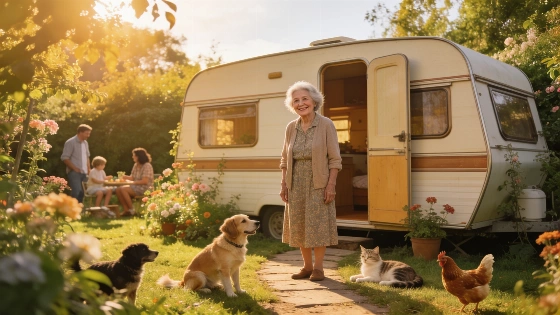
Jane’s turning point came when her younger daughter offered her a small prefabricated mobile home in the garden of her Florida property. The arrangement was meant to be temporary, but Jane soon realized the compact space offered what she needed: privacy and simplicity, with family nearby, without sacrificing her independence.
In practical terms, a separate residence on the same property as a basic home can function as an accessory dwelling unit, or ADU. These units may be detached cottages or additions, including conversions of existing space. For multigenerational households, they can give an older relative a distinct home while keeping family close, as Jane’s arrangement does.
She named her new home “La Tetera,” inspired by a story about a tiny English cottage just big enough for a table and two chairs. The name captured the spirit of her new life: modest and peaceful, with a personal touch.
Comfort, Memories, and Routine
Inside “La Tetera,” Jane surrounded herself with books and keepsakes, along with fossilized shells and handmade crafts. The small space also accommodates several pets, including dogs and cats, as well as chickens. They shape her daily routine and keep her company.
Jane says the home’s size is an advantage: everything is within reach, and a surface or wall is always nearby if she loses her balance. The only real drawback, she says, is the shortage of electrical outlets.
Independence with Family Close By
Living just steps from her daughter, Jane can get support when needed while keeping her own space and privacy. Her two great-grandchildren, aged four and eight, often visit and spend time with her and the animals. During a recent illness, Jane found comfort in being able to see her most cherished belongings from bed, each object tied to a memory.
Whether a small home can legally function as a separate dwelling depends on local zoning and building requirements, as well as how officials classify the structure. Florida’s rules vary by locality. Requirements may cover whether a second residence is allowed, its size and placement, and infrastructure needs such as utilities and wastewater capacity. Florida Statutes § 553.79 generally requires a building permit before construction, subject to statutory exceptions. Zoning approvals and inspections may also apply, along with anchoring requirements. The description “prefabricated mobile home” alone does not determine which rules apply.
Local governments have also considered ADUs as a housing option for families caring for older relatives. In Oldsmar, a proposal reported by Tampa Bay 28 would have made 274 additional parcels eligible for such units. The report used a 0.4% construction rate in St. Petersburg to estimate about 11 ADUs in Oldsmar over 10 years. At the time of that coverage, the city had made no final decision. The example shows how eligibility and development prospects can differ from one Florida municipality to another.
Jane acknowledges that tiny home living isn’t for everyone. For her, the move meant leaving behind the burdens of a traditional house while staying close to family and her animals, and keeping the tranquility she values in retirement. Her story, reported by Business Insider, shows how a smaller home on a relative’s property can offer independence with family nearby.