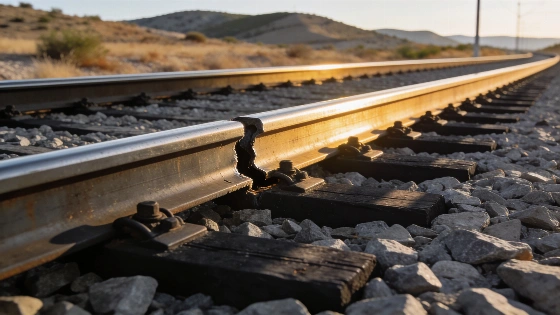
The rail at Adamuz had fully fractured about 22 hours before the crash, yet the track circuit did not register the line as occupied. Up to 47 trains reportedly crossed the damaged location before the derailment. Investigators say the break caused no loss of electrical continuity because current could travel through alternative routes, including cables and catenary-support elements. The circuit detected a voltage drop compatible with a break only later.
The derailment occurred on 18 January 2026 at kilometre 318.386 of the Madrid–Seville high-speed line in Córdoba. An Iryo train derailed, followed by a head-on collision with a Renfe Alvia service. The crash killed 46 people and injured more than 150, according to reporting based on court-filed expert material.
That finding appears in a full field-investigation draft now received by Cristina Pastor Recover, the judge handling the case at Montoro court in Córdoba. A separate advance report by the court-appointed experts, dated 20 November 2026, identifies a fractured weld as the most probable origin of the derailment, alongside ground settlement and track-deflection effects. The experts examined whether the failed weld joined a rail section installed in 2023 to another dating from 1989. They attributed the failure to poor execution and noted the sections’ different ages and hardness.
AITAT president Gonzalo Guillén told the judge that the attached document was prepared by the field investigation team at the court’s request. AITAT, the Autoridad Administrativa Independiente para la Investigación Técnica de Accidentes e Incidentes Ferroviarios, incorporated Spain’s former railway accident investigation body, CIAF, in July 2026. The draft had not been considered or formally approved by the authority’s governing council, so it was neither a provisional nor an official AITAT report. The judicial inquiry remains separate from the authority’s technical investigation.
The investigators’ central concern is that track circuits, which monitor electrical continuity through the rails to determine whether a section is occupied, cannot reliably detect a rail break when continuity remains through an alternative route. The report says this limitation has existed on Spain’s high-speed lines since their creation and is not unique to Adamuz. Thales, the circuit manufacturer, had warned that a break could remain undetected under those conditions.
The document also says Adif validated the product after its risk assessment classed the failure to detect such breaks as intolerable and catastrophic. The risk was then marked as cancelled on the grounds that rail-break detection fell outside the contract’s scope.
A separate question concerns track inspection. The State Railway Safety Agency says auscultation is 95% effective, but the draft records that none of the 44 high-speed rail breaks since 2017 was detected by that method. The 44 cases concern rail breaks, while the 95% figure relates to auscultation’s broader effectiveness. The figures show the detection record for the specific failure type examined in the draft.
SER had previously disclosed the investigators’ warning, which has also featured in an earlier rail report. The full draft contains three recommendations on detecting rail breaks. A later five-page AITAT note reduced them to one, asking Adif and the State Railway Safety Agency to introduce mitigating measures without reproducing the draft’s technical detail.