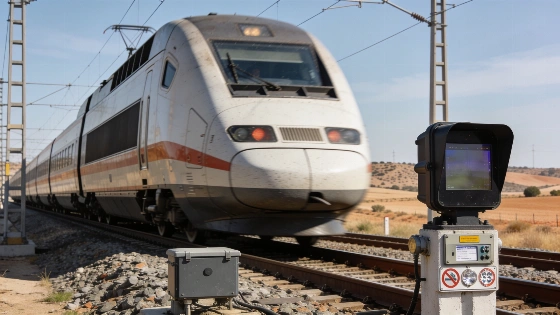
A separate LZB outage near Urda had left 63 kilometres of the Madrid-Seville line without continuous supervision before Monday’s incident shifted attention to the Levante corridor. The LZB failure occurred on 28 October 2026, affecting the section between Mora and Malagón after communication was lost at the Urda control centre at about 08:31. The LZB system has been in service on the line since April 1992, providing continuous cab signalling and train protection. The two lines use different signalling systems.
On Monday, 2 November, an ERTMS failure cut the Albacete Traffic Control Centre’s command and visibility over the standard-gauge infrastructure. The outage began at 14:38. Adif restored traffic-control capability at 15:00 using a backup Local Operations Post, but did not fully repair the fault until 15:32.
Five high-speed long-distance trains were affected, with an average delay of 20 minutes. The outage came four days after the accident at Urda, where a Renfe AVE train collided with a stationary Iryo train. The LZB communication failure preceded the collision by about 22 minutes; reports put the death toll at at least 69. Spain’s Transport Ministry data cited in reporting recorded 170 signalling or safety-system failures in 2026, 13 of them involving the Urda central system.
After the LZB stopped working at Urda, trains were managed using lateral signalling block (BSL) and ASFA. Traffic management moved to Adif’s Atocha control centre. Procedures required that trains not be authorised into an occupied section and that safety conditions be confirmed before movement resumed. ASFA transmits information through balises at specific points along the track, so its capabilities differ from those of systems that provide continuous supervision.
ERTMS and LZB rely on different technologies. LZB sends information through conductor cables between the rails; level 2 ERTMS communicates by GSM-R radio between trackside equipment and trains. Its ETCS component calculates braking curves and monitors speed. If operating conditions are breached, it can automatically order a train to stop.
Puente defended the reliability of both systems on Friday, 30 October, saying LZB offered security equivalent to ERTMS. He argued that replacing the German system was driven by interoperability and EU requirements. ERTMS, he said, would not have substantially changed what happened at Urda because it too can fail.
Addressing Congress on Tuesday, Puente said circulation rules spell out what to do when signalling systems fail. He also said 75% of system outages were caused by external factors, citing theft and weather before adding voltage drops.
The Government approved an extraordinary rail-safety plan on Tuesday. Under the plan, a second controller must validate decisions made during degraded operations when LZB or ERTMS is unavailable. Previously, one operator handled and signed those orders.
Other planned measures include software alerts and electronic records of communications. The package also includes checklists. The Government plans an artificial intelligence agent and a digital twin of the network to detect anomalies and anticipate incidents. The AESF is also to carry out an extraordinary review of safety systems and operating procedures.
Adif is completing tests to activate level 2 ERTMS on the Barcelona and Valencia corridors, as well as Seville and Extremadura, with service targeted for the first quarter of 2027. The system has been installed for years on the Barcelona and Valencia lines but remains switched off because of compatibility problems between onboard equipment and infrastructure.