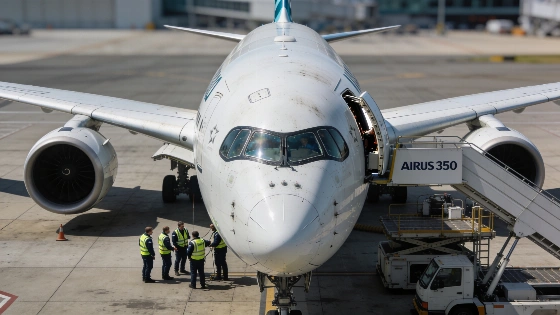
Airbus is finalizing certification for the A350-1000ULR, a jet designed for nonstop flights between Australia, Europe, and the US. Qantas will debut the world's longest commercial route, Sydney–London, in October 2027, cutting travel time by up to four hours.
On June 2, 2026, Airbus took a decisive step toward transforming long-haul travel when its first A350-1000ULR test aircraft, MSN 707, lifted off from Toulouse. The flight, lasting nearly four hours and reaching over 41,000 feet, marked the beginning of a rigorous two-month testing campaign aimed at certifying a jet capable of connecting Sydney directly to London and New York—routes previously impossible without a stopover.
The A350-1000ULR (Ultra Long Range) is engineered to operate the world's longest commercial flights. Its most significant innovation is a new rear central fuel tank holding 20,000 liters, extending the aircraft's range by 1,000 nautical miles to nearly 10,000 nautical miles (about 18,500 kilometers). This upgrade allows for direct journeys of up to 22 hours, eliminating the need for layovers and reducing total travel time between Australia and Europe by as much as four hours, according to Airbus.
Testing the Limits
Airbus has equipped the prototype with over 1,000 sensors to monitor fuel flow, temperature, and oxygen levels in the new tank, as well as a lighter cooling system for onboard kitchens. The next major test is scheduled for July 24, when the aircraft will attempt a nonstop 17,000-kilometer flight from Toulouse to Melbourne, pushing its operational boundaries and providing engineers with critical performance data.
Project Sunrise: A New Era for Qantas
Qantas has confirmed that the first commercial route under its Project Sunrise initiative will link Sydney and London starting in October 2027. Tickets are set to go on sale in February of that year. The airline expects the direct connection to save passengers up to four hours compared to the fastest current one-stop itineraries. Sydney–New York will also join the network, further expanding the reach of ultra-long-haul travel.
While Singapore Airlines already operates the A350-900ULR on the Singapore–New York route, the A350-1000ULR stands out for its combination of extended range and higher passenger capacity. Qantas will configure each aircraft with just 238 seats—its lowest-density A350 layout—across first, business, premium economy, and economy classes. The cabin will feature a dedicated wellness zone, allowing travelers to stretch and move during the marathon flights.
Efficiency and Passenger Experience
Airbus claims the A350 family delivers a 25% reduction in fuel consumption and CO2 emissions compared to previous-generation competitors, thanks to lightweight materials, advanced aerodynamics, and Rolls-Royce Trent XWB engines. For passengers, the elimination of stopovers means less time in transit and fewer airport hassles, but also requires careful attention to cabin comfort and crew management for journeys lasting nearly a full day.
Qantas has ordered 12 of the new jets, betting that demand for direct, ultra-long-haul travel will reshape global aviation. The move echoes broader trends in the industry, where airlines are seeking to differentiate themselves through unique routes and improved onboard experiences. The significance of family and legacy in aviation is also highlighted by stories such as the journey of a father and daughter flying together for Vueling, reflecting the evolving face of the airline industry.
As Airbus approaches the final stages of certification, the A350-1000ULR is poised to set a new benchmark for distance and endurance in commercial aviation. The first direct Sydney–London flight, scheduled for late 2027, will not only be a technical milestone but could also redefine what travelers expect from long-haul journeys.