A factory worker with chronic joint pain and retinal vein occlusion has lost her bid for permanent disability benefits. Despite multiple medical leaves and documented limitations, the court found she could still perform her main job duties. The ruling clarifies how Spanish law weighs medical evidence against work requirements.
The Tribunal Superior de Justicia de Castilla y León has rejected a factory worker's request for permanent disability status, finding that her health problems do not prevent her from doing the main tasks of her job. The decision, made public on August 31, 2026, confirms an earlier ruling by the Instituto Nacional de la Seguridad Social (INSS) and leaves the worker without the pension she had sought for years. According to Jurisprudencia laboral-social, this case was among the most notable labor and social security rulings in Spain between July 16 and August 31, 2026.
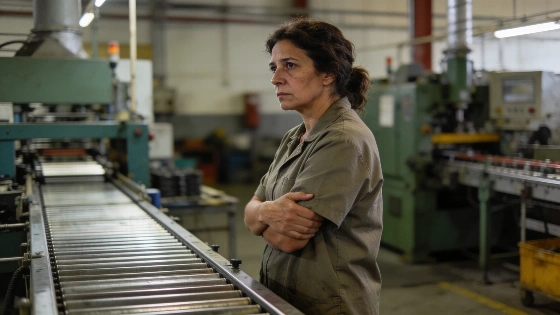
The dispute centers on a woman working as a peón on a production line. She had taken several medical leaves for chronic pain, limited movement in her right arm, and a retinal vein occlusion in her left eye. She argued that her conditions—mild lumbar osteoarthritis, ongoing neck and lower back pain, prediabetes, and significant vision loss—made it impossible to keep working in her usual role. She said she could not lift her arm above shoulder height, stand still for long periods, or handle heavy loads, all of which she linked to her assembly line duties.
In Spain, the annual base amount for a non-contributory disability pension for those without sufficient work history is set at €8,803.20 in 2026, illustrating the scale of regulated social benefits.
The INSS, after a medical assessment, found no major functional impairments. The evaluation noted she could walk without help, had no joint swelling, and showed normal results in neurological and muscle tests. The report concluded that while some restrictions were reasonable—such as avoiding heavy effort—these did not add up to a severe enough loss of capacity for permanent disability. The INSS based its decision on the recommendation of its Disability Assessment Team, whose findings, while not binding, usually carry significant weight. Spanish legal sources note that the INSS typically relies on the conclusions of the EVI (Equipo de Valoración de Incapacidades), and that only limitations that clearly prevent a worker from doing the core duties of their job can justify a permanent disability pension.
After her claim was denied, the worker appealed to the regional high court. The judges reviewed her medical records and the actual requirements of her job. They recognized her health problems and agreed that some activities should be limited, but decided that the severity and impact of her conditions did not meet the legal standard for permanent incapacity. Spanish law requires that permanent disability be reserved for cases where physical or functional limitations are both serious and clearly proven, and where these limitations prevent the worker from doing all essential tasks of their usual job. This strict approach means that the degree of actual work limitation—not just a diagnosis—remains the deciding factor for disability benefits.
The court's ruling does not set a general precedent for all workers with similar diagnoses. Each case depends on its specific facts and medical documentation. In some cases, Spanish courts have recognized disabling eye injuries or musculoskeletal conditions when the job's demands and the worker's limitations match more closely. The level of incapacity—partial, total, absolute, or severe—also affects the legal and financial outcome, with each category requiring a separate assessment of how the impairment affects job performance.
A recent case from August 30, 2026, saw a Spanish court order the INSS to grant disability status to a cleaner who could not lift more than 10% of her body weight, underscoring that courts focus on real work capacity rather than diagnosis alone.
This case also shows the importance of detailed, up-to-date medical reports and clear job descriptions when applying for disability. Without strong evidence linking each limitation to specific work tasks, claimants face an uphill battle. The court's documents did not specify the exact weights, pace, or detailed duties involved in the worker's job, focusing instead on general functions. This lack of detail likely weakened her case.
For those navigating Spain's disability system, the ruling is a reminder that the burden of proof is on the claimant. Only by showing how each health issue directly affects core job responsibilities can someone hope to win a claim. As seen in other employment disputes, such as those reported earlier, the details of the job and the quality of the evidence often decide the outcome.
The worker in this case can still seek review by Spain's Supreme Court, but such appeals rarely succeed unless there is a clear legal contradiction. For now, the message from the courts is clear: unless a worker's limitations are both severe and directly prevent them from doing the essential duties of their job, permanent disability status will not be granted. This approach may give clarity to employers and the Social Security system, but it leaves many workers with chronic but not fully disabling conditions in a difficult position—caught between medical reality and legal standards that require near-total loss of function before granting lasting support.