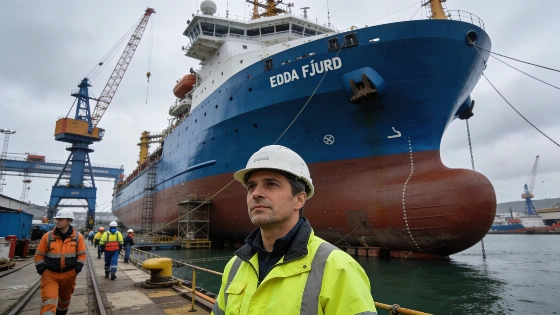
This Thursday afternoon, the Edda Fjord, a 120-meter vessel built for offshore energy work, will be launched at the Figueras shipyard in Asturias. The event marks a major step for Gondán and shows how Spanish shipbuilding is adapting to the demands of the maritime energy sector.
About 400 people have worked on the project, making it one of the largest undertakings in the region. Commissioned by Norwegian company Østensjø Rederi, the Edda Fjord is designed to support offshore wind farms and handle submarine cable laying and repairs, while also transporting crews to marine installations. Its hybrid propulsion and battery systems are paired with heat recovery technology, all intended to reduce energy use and emissions. Local media, including LNE and La Voz de Galicia, report that the launch is set for 10 September 2026, between 15:30 and 16:00, timed with the tides in the Eo estuary. It is the largest vessel Gondán has built in more than a century of operation.
The ship measures 120 meters long and 23 meters wide, with accommodation for 173 people, though some sources, including La Voz de Galicia, cite slightly higher numbers. Official documents do not explain the discrepancy. After completion, the Edda Fjord will weigh approximately 7,000 tons and stand over 40 meters tall, La Voz de Galicia reports. Recent reports suggest the ship could carry up to 180 people, reflecting design updates.
Logistics and delays
The launch, planned for 16:00 on 10 September 2026, has already faced delays. Originally scheduled for July, it was pushed back to avoid the busy summer boating season and align with the tides. Dredging in the Figueras channel has continued up to the last minute to provide enough depth for the launch. Weather or technical issues could still prompt changes, but interest is strong on both sides of the Eo estuary. Puente de Mando notes that last-minute adjustments are common for launches of this scale.
The launch does not mean the Edda Fjord is ready for service. Delivery to Østensjø Rederi is expected in the second half of 2027, after months of outfitting and testing. This phased approach is standard at Spanish yards such as Navantia, where ships often float for months before crews install final systems and begin sea trials.
Economic impact and workforce
The project is backed by a guarantee line of over 125 million euros from CaixaBank, announced in October 2024. The guarantee secures the contract but does not represent the vessel's final price. Gondán estimates that about 400 workers will be involved throughout the build, though that figure covers all phases and does not mean 400 new jobs. The contract extends a long partnership between Gondán and Østensjø Rederi, now totaling 23 vessels. LNE describes the project as an industrial and symbolic basic stage for Asturias, strengthening the region's role in green shipbuilding.
Gondán is also investing 15 million euros to expand and modernize its facilities, aiming to keep its order book full through 2030. Current projects include four 70-meter patrol boats for Indonesia and two research vessels for the German government. The yard is also building three passenger catamarans for Sweden. The Edda Fjord, known internally as Gondán Max, is the flagship of this new phase.
Strategic significance
The Edda Fjord’s launch shows Spain’s growing role in the offshore energy supply chain and highlights the technical abilities of regional shipyards. As the vessel enters the water, Gondán is positioning itself as a basic player in the shift to cleaner maritime operations, drawing on international partnerships and local expertise.
The project’s investment and technical complexity, alongside its international collaboration, reflect a rapidly changing sector. For Asturias, the launch brings together industrial ambition and global relevance on the banks of the Eo.