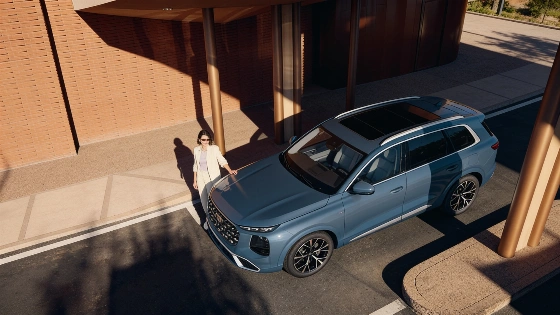
The third-generation Audi Q7’s 3.0-litre V6 TDI produces 299 PS and 630 Nm in its more powerful version. The lower-output engine delivers 245 PS and 500 Nm. Both launch engines use MHEV plus assistance. The integrated generator can provide up to 18 kW, or approximately 24 PS, temporarily.
Every configuration has permanent quattro lead and an eight-speed tiptronic automatic gearbox. The standard layout has five seats; individual seats in the second row create a six-seat option, while seven seats remain available for families needing the extra capacity. The Q7 nameplate dates back to 2005, when Audi entered the SUV segment with its first model in the line.
Practical details matter here. In five-seat form, the boot holds 806 litres, rising to 2,075 litres with the second row folded. Even with seven seats fitted, 722 litres remain behind the second row. The second row can take up to three child seats in five- and seven-seat versions, and its 65/35 split lets passengers reach the third row without removing them.
Access is designed around everyday use. The second-row seats tilt forward without folding completely. An electric tailgate opens with a foot gesture, and a light on the ground marks where to place a foot. Rear USB-C ports provide up to 60 W in the second row and 100 W in the third.
A door-exit warning can prevent a door from opening when it detects an approaching cyclist. Up front, a curved OLED panel brings the digital instruments and MMI touchscreen together, with a separate display for the passenger. Optional digital Matrix LED headlights use micro-LED technology and can project information onto the road.
On the move, the V6 works with MHEV plus technology. An integrated generator can contribute up to 24 CV and 370 Nm when needed, including during a start or a quick overtake. An electric compressor is designed to sharpen the engine’s response and cut the wait for boost. The launch versions are mild hybrids, not plug-in hybrids.
The eight-speed tiptronic gearbox works with a new preloaded self-locking centre differential in the permanent quattro system. The Q7 comes with steel springs as standard; buyers can choose adaptive air suspension or a sport air setup that lowers the body by 30 mm. Optional four-wheel steering is also available. The front brakes use 400 mm discs with fixed six-piston calipers, and buyers can choose wheels up to 23 inches.
In Spain, launch prices listed by Auto10 were €95,630 for the 245 PS version and €98,500 for the 299 PS model. The publication listed official fuel-consumption ranges of 7.1 to 7.8 litres per 100 km and 7.2 to 8.0 litres per 100 km, respectively, depending on configuration.
The initial European range is diesel-only, with a V6 petrol version and plug-in-hybrid variants reported as planned for later. The roofline stays almost horizontal, while the revised D-pillar is intended to improve headroom. That design detail connects to a broader discussion of shared styling cues in this design analysis.