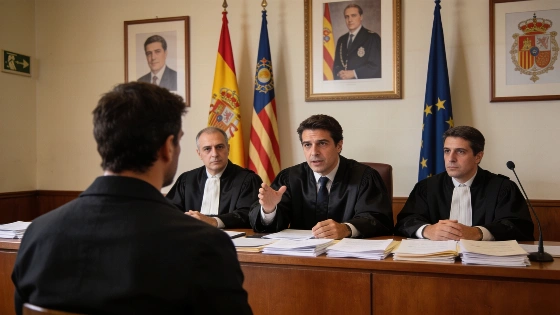
The Badajoz court has clarified that nepotism and absenteeism, while ethically questionable, do not always constitute crimes. David Sánchez, brother of the Prime Minister, faces a nine-year ban for administrative misconduct.
The Provincial Court of Badajoz has delivered a verdict that goes beyond the individual case of David Sánchez, brother of Prime Minister Pedro Sánchez, by directly addressing the boundaries between ethical failings and criminal acts in public administration. The court sentenced David Sánchez and Luis Carrero to nine years of disqualification from public office for administrative misconduct, but made clear that neither nepotism nor absenteeism automatically amount to criminal offenses under Spanish law.
In its detailed ruling, the court openly discussed the issues of “nepotismo” and “absentismo”, both of which were central to the prosecution’s case. The judges described these practices as “ethically censurable” but stressed that only specific, legally defined actions can be prosecuted. Notably, the court underlined that absenteeism is not, and has never been, a criminal offense in Spain. The verdict focused on the creation and allocation of two high-level positions within the Badajoz provincial government—one for Sánchez as head of the Oficina Artes Escénicas, and another for Carrero—positions the court found were tailored to personal interests rather than genuine administrative needs.
The court identified Miguel Ángel Gallardo, former president of the Diputación de Badajoz, as the main perpetrator of the administrative misconduct, with Sánchez and Carrero as necessary collaborators. According to the judges, the jobs were created without urgency or necessity, allowing the appointees to pursue their own interests, particularly in the field of opera, at public expense. The court dismissed rumors and speculation about political influence, stating that there was no concrete evidence to support charges of influence peddling. This echoes earlier coverage, such as the government’s response to the ruling, which can be found in reports like the government’s defense of David Sánchez after the Badajoz court decision.
During the trial, attention was drawn to an intercepted email suggesting Sánchez obtained his position due to his family ties. However, the court discounted this as unsubstantiated rumor, emphasizing that legal proceedings must be based on proven facts, not hearsay. The judges also noted that while nepotism undermines democratic health and public trust, it only becomes a crime when it fits specific legal definitions, such as administrative misconduct or influence peddling. In this case, only the former was proven.
The issue of absenteeism was highlighted by Sánchez’s own admission during the investigation phase, when he stated he did not know the physical location of his office. He later clarified that he viewed his role as an administrative category rather than a fixed workplace. The court found that Sánchez neglected his duties from the outset, rarely attending his post and failing to coordinate the province’s conservatories as required. Despite this, the judges reiterated that absenteeism alone is not a criminal matter in Spain, and the focus of the trial remained on whether the creation of the jobs constituted a gross and arbitrary misuse of public authority.
Contextually, the case has sparked debate about the standards for public sector hiring and the distinction between unethical conduct and criminal liability. In Spain, administrative misconduct (prevaricación administrativa) is a specific offense that applies only when public officials make decisions that are clearly illegal and contrary to the legal order. Nepotism, while damaging to public confidence and efficiency, is not prosecuted unless it meets this threshold. The Badajoz ruling reinforces the principle that ethical lapses must be clearly linked to statutory crimes to result in legal penalties. This case also highlights the ongoing scrutiny of public appointments and the importance of transparent hiring practices in Spanish institutions.