At Sir Victor, curved limestone and a library connect the hotel to Caterina Albert i Paradís, who wrote under the name Víctor Català.
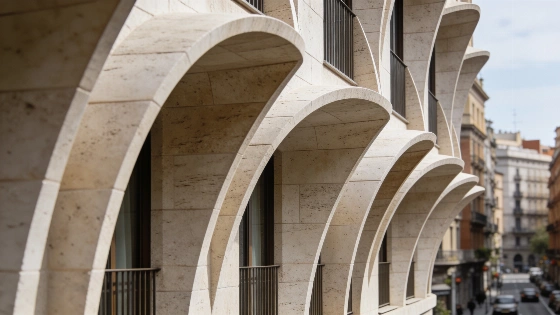
At the corner of Carrer de Rosselló, the hotel’s stone façade does the first bit of storytelling.
Sir Victor builds on the identity of Caterina Albert i Paradís, who published as Víctor Català to write freely in a period shaped by patriarchal judgment. The hotel turns that history into a series of spaces centered on individuality and freedom. It does not attempt to reconstruct her life.
The building stands where the Eixample meets the edge of Gràcia. Curved limestone panels open outward like pages. Capella Garcia Arquitectura designed the façade in 2003 for the building that first housed Hotel Omm. Sir Victor kept the sculptural exterior and gave it a new meaning: its stone fins filter light and shield guest rooms from view, while setting up the literary theme.
El Periódico has also examined Barcelona hotels through their connections with the city’s history.
The original design had no connection to Víctor Català. That came later, when the hotel adopted its current identity. Myriel Walter, Sircle Collection’s vice-president of brand and membership, says the author’s independence and refusal to accept convention helped shape the concept. The façade’s resemblance to an opening book gave the hotel a ready-made visual metaphor.
Inside, Baranowitz + Kronenberg, known as B+K, work with contrast rather than period decoration. Pale oak flooring meets a Carrara marble billiard table. Bocci light spheres brighten the lobby. Further in, MR PORTER shifts the mood: walnut and copper set a darker tone, with black leather and bevelled marble adding to the enclosed feel.
The contrast is deliberate.
B+K set masculine and feminine visual cues against each other, echoing the tension between the author’s pen name and the identity behind it. Some surfaces appear soft and pliable, though they are made from hot-rolled steel. Here, the materials carry the point: appearance and substance do not always match.
The available excerpt does not identify Sir Victor or substantiate claims about its façade and design. It offers citywide context about Barcelona hotels and history, rather than independent confirmation of the hotel-specific details described here.
The 91 rooms and suites are quieter. Cassina and B&B Italia furniture sits alongside Nani Marquina rugs. Abstract canvases by Bernat Daviu complete the rooms, where the hotel leaves literary references in the background and lets the materials and artwork carry the design.
The clearest tribute is The Study, a library with a selection devoted to women writers. It gives the Sir Victor name a tangible link to the author whose pen name inspired it. Walter says curiosity is central to the experience: guests should find another layer beyond the first impression.
The hotel’s literary focus sits apart from the legal questions raised by a Spanish nationality vote. Sir Victor approaches identity through architecture and literature. Its shared spaces extend the idea beyond the building’s story: The Rooftop looks towards Casa de les Punxes. The Cover is a private members’ club intended to bring local residents and hotel guests into the same space.