The Hospital Universitario de Bellvitge has performed Europe’s first robotic living-donor kidney transplant through one seven-centimetre incision. The patient has been discharged and two more procedures have followed.
Bellvitge carried out 207 kidney transplants in 2025, more than any other hospital in Spain. The Barcelona centre has also completed a European first: a living-donor kidney transplant performed robotically through a single seven-centimetre incision. The operation took place in September 2026, and the patient has been discharged.
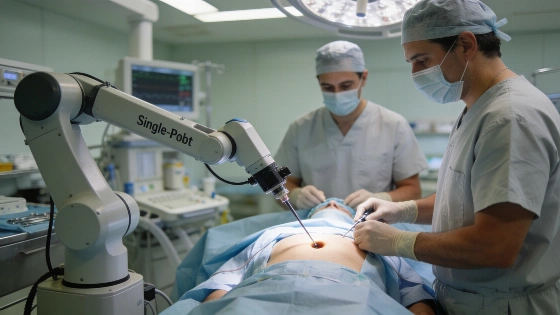
The operation was performed using the Da Vinci SP (Single Port) system. Since then, the hospital has completed two more transplants using the technique. Before Bellvitge’s procedure, this type of transplant had been performed at only one hospital in the United States, in Cleveland.
The difference is the surgical access. Conventional multiport systems use several small abdominal openings for the camera and instruments, alongside a larger incision for the kidney. The Da Vinci SP brings its camera and three micro-articulated instruments together through one access point, with a 3D endoscope controlled from an external console. Surgeons use the same seven-centimetre opening to insert the organ. The system’s instruments can move through a 360-degree range.
For patients, the approach means one scar. Óscar Buisan, head of Urology at Bellvitge, says the single incision is expected to reduce postoperative pain and help patients regain function sooner. The hospital says transplant outcomes are comparable to those of conventional robotic surgery. The technique is not suitable for every patient; selection depends on the recipient’s anatomy and the characteristics of the donor kidney.
The centre has used robotic surgery for kidney transplants since 2018 and has carried out around 300, placing it among Europe’s reference hospitals for the procedure. The single-port approach changes the surgical access, while the basic transplant procedure remains the same.
Bellvitge was also the first hospital in the world to perform an orthotopic kidney transplant using robotic surgery, in 2020. In this operation, the new kidney is placed in the same anatomical space as the diseased one. In most transplants, the patient’s own kidneys remain in place and the donor organ is placed in the iliac fossa in the lower abdomen, where it is connected to blood vessels and the urinary tract.
The hospital has six surgical robots and performed about 1,200 robotic procedures of all types in 2025. It expects that total to reach 1,600 in 2026 and nearly 2,000 in 2027. Bellvitge also forecasts 350-400 procedures using single-port robots in 2026 and 500-600 in 2027; those figures cover all procedures using the system, not kidney transplants alone.