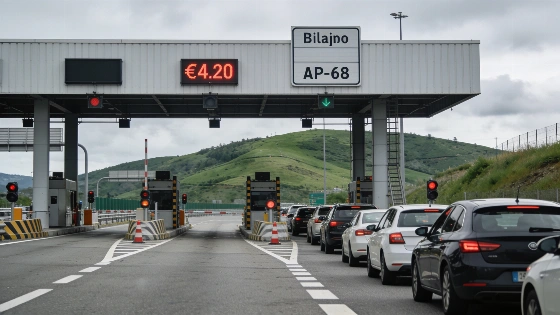
Bizkaia will maintain tolls on the AP-68, with a single trip between Bilbao and Vitoria costing €4.20. From 2027, regular users will see a monthly cap of €35 for tolls within the province. The measure aims to reduce costs for frequent drivers.
Drivers in Bizkaia will continue to pay tolls on the AP-68, as the provincial government confirms the fee for a single journey between Bilbao and Vitoria will be set at €4.20. The announcement, made by Carlos Alzaga, the deputy for Infrastructure, comes as the management of the Bizkaia section of the AP-68 transitions to Interbiak from November 11. The move is part of a broader overhaul of toll policies in the region.
Starting January 1, 2027, Bizkaia will introduce a monthly spending cap for frequent users of toll roads within the province. Regular drivers will pay no more than €35 per month for journeys on local toll roads. For those who travel across provincial borders, using the AP-8, AP-1, and AP-68 in Álava and Gipuzkoa, the cap will be €53. Both limits represent a €5 monthly saving compared to current rates, according to the authorities.
While the AP-68 will become toll-free in Aragón, Navarra, La Rioja, and Burgos, tolls will remain in place in Euskadi. Both Álava and Bizkaia have decided to continue operating their sections of the motorway after the end of the national concession. Álava has announced discounts of up to 70% once its section is released, while Bizkaia will reduce average tolls by 20% for both light and heavy vehicles.
Currently, the cost of traveling from Bilbao to Vitoria stands at €6.85, but the exact breakdown between the two provinces is disputed. Bizkaia estimates its section at €4.20, attributing the remaining €2.60 to Álava. However, Álava's authorities previously set their portion at €3.52, suggesting Bizkaia's share would be €3.33. The 22.3-kilometer stretch of the AP-68 in Bizkaia is the last segment to be integrated into the provincial road network.
Alongside the new tariffs, Bizkaia will apply a €5 reduction to the maximum monthly charges for frequent users. Those who drive exclusively on Bizkaia's toll roads will face a €35 cap, while those traveling into Gipuzkoa or Álava will see the €53 limit. The province currently allocates €11 million to a bonus program for regular toll road users, benefiting nearly 29,000 people—a figure expected to rise to 32,000 by year-end.
The provincial government defends the pay-per-use model, arguing that toll revenues are essential for road maintenance and align with European standards. Officials note that Spain remains an exception within the EU, where the principle of "who uses, pays" is widely applied. The current staff of the state concessionaire AVASA will be retained during the transition, and existing toll booths in Bizkaia will remain operational for now. Although electronic tolling systems like 'free flow' are planned for the future, about 8% of drivers still pay in cash.
For context, the debate over road charges and infrastructure management is not unique to Bizkaia. Across Europe, regulatory changes and enforcement actions have affected major transport operators, as seen when the European Commission imposed a record fine on AliExpress for failing to control illegal sales—an event that highlighted the growing scrutiny of cross-border services. More details on this can be found in the report on the EU's penalty against AliExpress.
Spain's approach to toll roads has evolved over the past decade, with several national concessions expiring and some regions opting to remove tolls entirely. However, in the Basque Country, the focus remains on balancing infrastructure funding with user costs. The new caps in Bizkaia are designed to ease the burden on frequent commuters while maintaining the financial sustainability of the road network. As the transition to electronic tolling continues, authorities face the challenge of accommodating both digital and cash users, ensuring accessibility and efficiency for all drivers.