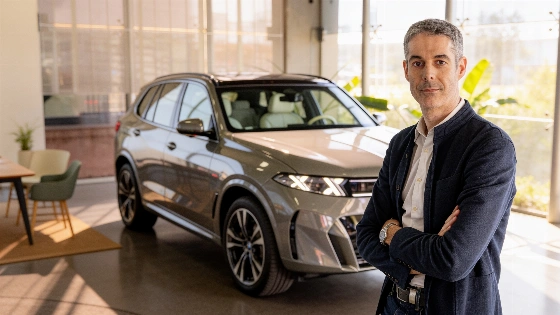
BMW designer Jacobo Domínguez says the electric and combustion versions of the BMW X5 share exactly the same exterior design. The challenge, he says, was to shape a front end that meets the aerodynamic needs of both types while keeping their appearance identical. The fifth-generation 2027 X5 applies BMW’s Neue Klasse design language to familiar large-SAV proportions, with an upright front and narrower, vertically aligned kidney grilles.
The solution uses a black panel that incorporates aerodynamic elements, some of which open or close as required. Domínguez says the design keeps the exterior consistent across both versions. The broader X5 family is reported to offer five drive-system technologies, while the all-electric iX5 is listed with 578 horsepower and a provisional WLTP range of up to 845 kilometres.
The Neue Klasse design language brings cleaner surfaces to the X5. The team removed the exterior plastic around the wheel arches and air outlets. It also eliminated the window frames. For the first time, the door handles move from the bodywork to the glass area. The new BMW Winglet handles sit near the B- and C-pillars, complementing the smoother side surfacing.
Domínguez singles out the rear shoulders as the feature that gives the SUV its distinctive presence. Their pronounced volume, he says, is more commonly associated with sports cars. The front draws on BMWs from the 1960s through the 1980s, reworking the shark nose and narrow vertical kidneys alongside paired headlights and a horizontal black band. The new lighting signature uses “double-X” graphics, while the overall design retains the X5’s established proportions.
His references include the BMW Garmisch, created by Marcello Gandini in 1970, and his own BMW Serie 5 E28. He also points to the X-shaped details in the lights, recalling adhesive strips once placed over racing-car headlights to protect the glass. BMW’s Neue Klasse direction also carries into the cabin, with a 17.9-inch central touchscreen and Panoramic iDrive projected across the lower portion of the windscreen.
For Domínguez, proportions establish a car’s first impression; he estimates they account for 70% to 80% of its appeal. Emotional character matters too: a technically resolved design may still fail to be memorable. BMW’s campaign presenting Neue Klasse as a reinterpretation of its established design cues has also invoked the kidney grille, introduced in 1933, and the Hofmeister kink, associated with the marque from 1961.
That emphasis on a marque’s identity reaches beyond BMW. RUSSPAIN has also covered Ebro’s identity as a Spanish-owned carmaker. Domínguez says BMW’s cars are the work of a team, even when one person receives credit for the original proposal.
He has spent more than two decades in the BMW Group, including work with Rolls-Royce, and began his training as an architect. He says the two disciplines share a creative process centred on designing a space around human needs. A car, he adds, must also reflect BMW’s sporty, athletic character, with elegance as part of the mix. The new X5 made its UAE debut in early November 2026, alongside the iX5 and a broader Neue Klasse rollout across BMW’s range.