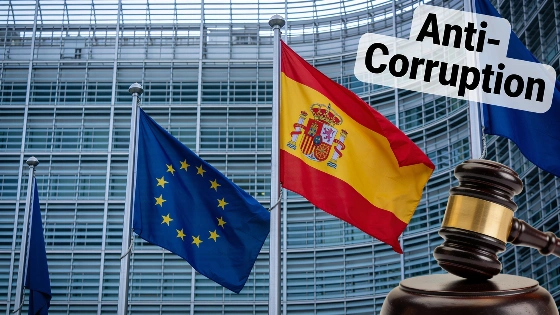
The European Commission warns Spain has made only limited progress on anti-corruption reforms. Brussels calls for faster action to strengthen prevention and oversight, and to guarantee the independence of the supervisory body.
The European Commission has sharply criticised Spain for failing to deliver meaningful progress on its anti-corruption reforms, highlighting that the government’s much-publicised plan remains largely unimplemented. In its latest rule of law report for 2025, Brussels points out that Spain has yet to strengthen regulations on conflicts of interest and asset declarations for senior officials, despite the approval of the State Anti-Corruption Plan and ongoing discussions around the future Organic Law on Public Integrity.
Brussels is now urging Spain to accelerate reforms aimed at reinforcing mechanisms for preventing and controlling corruption, and to ensure the independence of the body responsible for oversight. The Commission also stresses the need to guarantee the effectiveness and autonomy of the supervisory authority’s powers to detect and sanction wrongdoing.
This annual assessment comes a year after the Spanish government unveiled a 15-point anti-corruption package, which included proposals such as creating an independent Public Integrity Agency, strengthening whistleblower protections, introducing new tools for monitoring public procurement, and toughening penalties. The plan was announced amid a wave of corruption scandals involving figures like former minister José Luis Ábalos and ex-PSOE organisation secretary Santos Cerdán.
However, the Commission notes that most of these measures remain stalled, pending the approval of the relevant organic law in Congress. The report also finds that the practical application of existing anti-corruption rules has not improved, and recommends expediting the legislative process to reinforce the regime for conflicts of interest and asset declarations, as well as to secure the independence and effectiveness of the sanctioning authority.
The warning comes at a time of heightened political tension in Spain, following the conviction of the prime minister’s brother for prevarication and ongoing judicial proceedings against his wife, Begoña Gómez. The government continues to face fallout from the Koldo case and related investigations, while the Partido Popular is still dealing with the repercussions of major corruption cases such as Kitchen, alongside other judicial challenges in regions under its control.
Although the Commission’s report does not mention specific scandals, it repeatedly calls for stronger institutional safeguards to prevent conflicts of interest, boost transparency, and guarantee the independence of oversight bodies. The anti-corruption recommendations are part of a broader evaluation of Spain’s rule of law, which finds that while most pending reforms have advanced, they remain incomplete. Key issues include finalising the reform of the system for appointing members of the General Council of the Judiciary in line with European standards, approving changes to reinforce the independence of the Attorney General by separating their mandate from the political cycle, speeding up investigations and proceedings in high-level corruption cases, and passing a law to regulate lobbying activities for the first time through a mandatory register.
The Commission also highlights ongoing tensions between the judiciary and political powers, noting that judges and legal professionals continue to express concern over public criticism of judicial decisions by politicians—a concern shared by the Supreme Court, the General Council of the Judiciary, judicial associations, and the Constitutional Court. At the same time, the report acknowledges that some judges have also publicly criticised politicians, with several cases now under review by the CGPJ’s Disciplinary Commission. The Commission reminds all branches of government that, while criticism of judicial rulings is part of democratic debate, the executive and legislative powers must avoid undermining judicial independence or public trust in the courts, and calls for mutual respect among state institutions.
Spain’s position in the Transparency International Corruption Perceptions Index reflects these challenges. With a score of 55 out of 100—one point lower than the previous year—Spain ranks 49th globally and 17th among EU member states, trailing Portugal and Slovenia but ahead of Italy and Poland. The Commission’s report notes that Spain shares similar recommendations with countries like the Czech Republic, Malta, Italy, and Austria, all of which are urged to strengthen rules on conflicts of interest and asset declarations for senior officials. In contrast, the Commission reserves its harshest criticism for Slovakia, Hungary, and Bulgaria, where it finds a sharp deterioration in the ability to detect, investigate, and prosecute high-level corruption.
These findings underline the persistent gaps in Spain’s anti-corruption framework and the need for concrete legislative action. The Commission’s call for accelerated reforms and stronger oversight mechanisms signals ongoing scrutiny from Brussels, as Spain seeks to improve its standing and address institutional weaknesses in the fight against corruption.