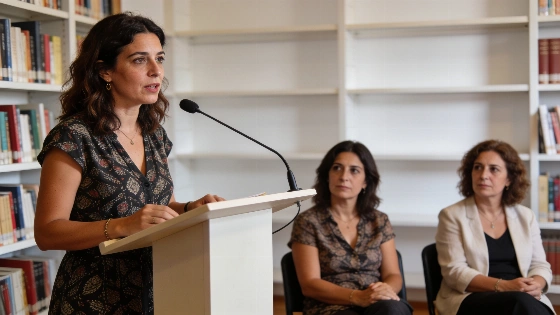
Around 15 published authors from Cabanillas del Campo read at the Biblioteca León Gil for Día de las Escritoras 2026. More than 60 people attended a programme ranging from professional essays to literary work in prose and verse.
At the Biblioteca León Gil, readings ranged from essays on Biology, Social Work, Pedagogy and Education to fiction and poetry. Around 15 writers from Cabanillas del Campo took turns at the lectern on Monday 19 October before an audience of more than 60. In Spain, Día de las Escritoras is held on the Monday closest to 15 October, the day commemorating Santa Teresa de Jesús.
The authors had all published at least one book in recent years. The Biblioteca Municipal organised the event, giving participants space to introduce their professional and literary work before reading from published books or writing still in progress.
Rosa María García Ruiz, the councillor for Culture, presented the event after the library director, Pilar de Isidro, welcomed attendees. García Ruiz described the day as a celebration of women who use writing to express a way of seeing the world. She also recalled the barriers women faced in publishing and gaining recognition, and the many writers left out of the established literary record.
Día de las Escritoras was established in 2016 by the Biblioteca Nacional de España (BNE), the Federación Española de Mujeres Directivas, Ejecutivas, Profesionales y Empresarias (FEDEPE) and the Asociación Clásicas y Modernas. The annual initiative aims to bring women’s literary contributions into view and restore the memory of authors whose work was forgotten or excluded from the canon. Its Monday observance closest to 15 October fell on 19 October in 2026.
The 2026 national programme took the theme “Las amigas como forma de libertad” (“Friendship as a form of freedom”) and marked the centenary of Madrid’s Lyceum Club Femenino, founded in 1926 as a space for women’s intellectual and social exchange. The BNE programme featured letters, diaries, essays, speeches, memoirs and poems by women associated with the club. Curator Christina Linares noted that many accomplished women writers had remained outside the literary canon.
The Lyceum Club Femenino was established in November 1926 under the leadership of María de Maeztu. According to El Mundo, it grew from around 100 members at its founding to approximately 700 by the time it ceased to exist in 1939. Figures associated with its history include Victoria Kent, Clara Campoamor, Mercedes Pinto, Victorina Durán, Carmen de Burgos, Elena Fortún, Luisa Carnés and Irene Polo.
Other cultural projects have also brought Spanish literary figures to public audiences. RUSSPAIN covered the Instituto de Estudios Riojanos’ illustrated school project on Rafael Azcona in its account of the project.
The readers included Rosa María García, Paloma Gavilán, Viviana Barnatán, Mar Santos, Mayte Rod, Ana Yela, Sagrario Muñoz and Sara Pérez. Carmen Baldominos, Montse Jiménez, Paula Hernández, Toñi Roldán, Elena María Robles, Concha Soria and Matilde Sanz also took part.
The event ended with a group photograph of the writers. Matilde Sanz is due to present her second book of poems at the same library next Friday. Día de las Escritoras was also marked elsewhere in Guadalajara province in 2026, including a first citywide celebration in Guadalajara honouring local women authors.