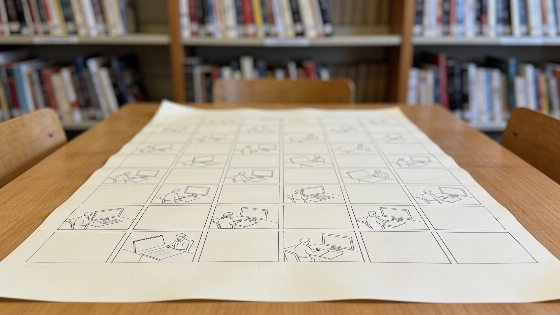
The Instituto de Estudios Riojanos is printing 1,000 DIN A2 copies of an illustrated auca about Rafael Azcona. Schools across La Rioja will receive copies, and the publication will also be sold through the institute’s bookshop.
Azcona’s story starts in Logroño and brings him back there as an established screenwriter. Born in the city on 24 October 1926, he died in Madrid in 2008. The Instituto de Estudios Riojanos (IER) is marking the centenary of his birth in 2026 with an auca told through 24 illustrated scenes and verse fragments. It is printing 1,000 copies for educational centres throughout La Rioja.
The DIN A2 publication is available from the IER bookshop at calle Portales, 2, Logroño, and through its online shop, libreriaier.larioja.org. Pedro Espinosa created the illustrations. Luis Alberto Cabezón García wrote the visual script and texts.
An auca is a traditional form of illustrated popular storytelling. The format emerged in Catalonia in the 18th century and later spread across Spain as aleluyas. Each sheet is divided into numbered panels, usually paired with rhyming couplets or quatrains. The stories were originally read aloud or sung; some were recited.
Brief verses and images helped the format carry stories between generations. Subjects ranged from saints’ lives to historical events. Children’s tales and biographies of notable figures also appeared. The IER is using the form to introduce Azcona’s life and work to readers of different ages, tracing his early years in Logroño through his rise as one of Spanish cinema’s leading screenwriters.
Azcona began as a writer before moving into cinema. His first major film work was the screen adaptation of his own novel El pisito. He went on to write more than 100 screenplays, working with directors Luis García Berlanga and Carlos Saura. His other collaborators included José Luis Cuerda and Fernando Trueba.
Among his best-known films are Plácido, released in 1961, and El verdugo, released in 1963. His credits also include La escopeta nacional from 1978 and La vaquilla from 1985. Belle Époque followed in 1992. Agencia EFE has reported that Azcona’s six Goya Awards remain the highest total for a screenwriter.
The auca is one part of the institute’s centenary programme. A monograph of the journal Berceo is due out, and a sound fiction based on one of Azcona’s works is being recorded with RTVE. The Rafael Azcona research prize is awaiting its next decision.
The magazine Belezos has marked the centenary with a cover report. In May, during the opening day of the IX Congreso Nacional de Guionistas, the IER held a round table titled 'El guion vuelve a casa'.
The institute’s library has a themed corner dedicated to the screenwriter, who was born in Logroño. It includes objects and representative works and is open to visitors until January. Recent Spanish arts coverage has also included the photography prize report.